
Introduction
Drones have moved beyond hobby use and are now widely applied across commercial, industrial, and public sectors. Their ability to capture data, automate tasks, and reach difficult locations has increased adoption globally. Improvements in flight stability, arifi, and battery efficiency have expanded use cases. As a result, the drone market continues to show steady growth.
Leading drone companies play a central role in this expansion by setting technology benchmarks. Their investments in research, manufacturing, and software integration shape market direction. These companies also influence pricing and regulatory compliance standards. Their scale and innovation capacity support wider acceptance of drone technology.
Market Snapshot
The global drone market includes consumer, commercial, and defense-grade unmanned aerial systems. Commercial and industrial applications account for a growing share of demand. Key usage areas include mapping, inspection, agriculture, logistics, and surveillance. Software and services are increasingly bundled with hardware sales.
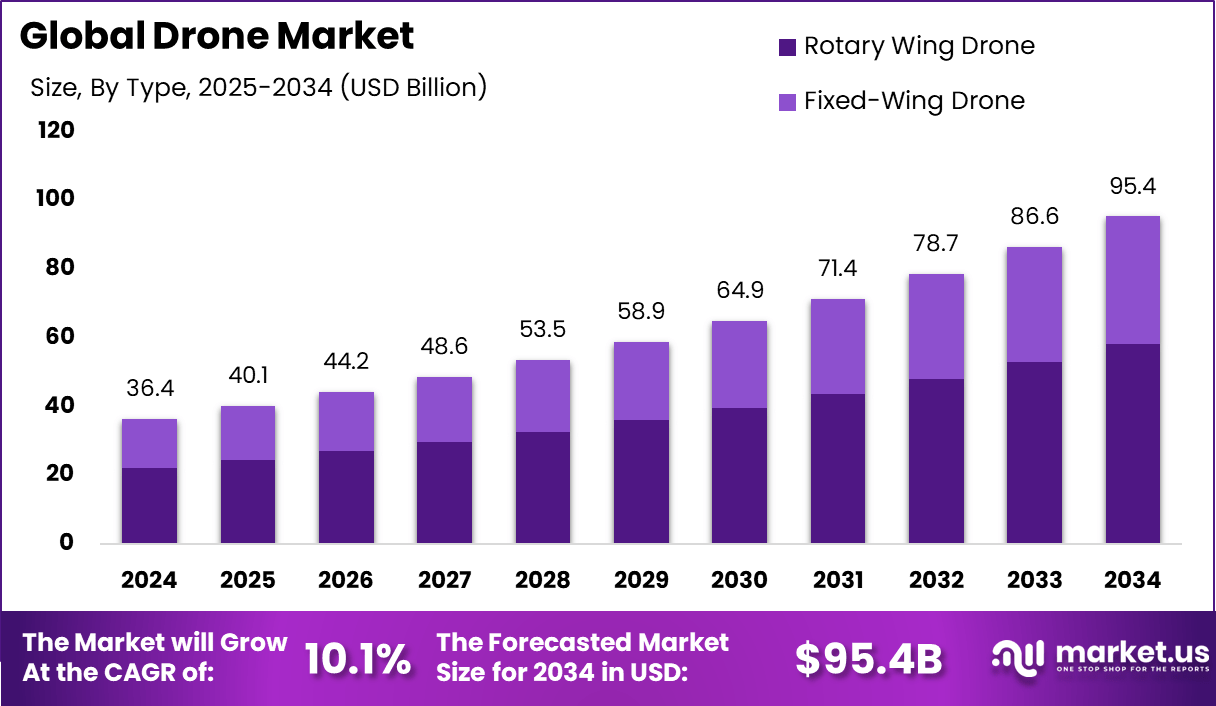
According to market.us, The global drone market is projected to grow steadily over the coming decade. The market size is expected to reach around USD 95.4 billion by 2034, rising from USD 36.4 billion in 2024. This growth reflects a compound annual growth rate of 10.1% during the forecast period from 2025 to 2034. The expansion is supported by increasing use of drones across commercial, industrial, and public sector applications, along with continuous improvements in drone hardware, software, and flight capabilities.
In 2024, the Asia Pacific (APAC) region held a dominant position in the global drone market. The region accounted for more than 40.2% of total market share, generating approximately USD 14.63 billion in revenue. Strong manufacturing capabilities, rising adoption of drones in agriculture, infrastructure monitoring, logistics, and public safety, along with supportive government initiatives, contributed to this leading position. APAC is expected to remain a key growth region as drone usage continues to expand across both developed and emerging economies.
(source: market.us)
Key Takeaways
- In 2024, the Asia Pacific region held a leading position with over 40.2% market share, generating USD 14.63 billion in revenue, supported by strong adoption in China, Japan, and India for both commercial and defense uses.
- The rotary wing drone segment dominated the market in 2024, accounting for 61.1% of total market share, mainly due to its flexibility and ease of use across applications.
- Fixed wing drones continue to gain traction, with their market share rising from 31.7% in 2019 to 38.9% in 2024, driven by demand for long-range and endurance-focused operations.
- By application, the military segment remained the largest in 2024, capturing 48.8% of the market, supported by increasing use of drones for defense operations, border surveillance, and intelligence activities.
Drone Statistics
- Based on data from hiredronepilot.uk, 855,860 drones are registered with the FAA in the United States, showing strong nationwide adoption.
- China generated USD 1.4 billion in drone revenue, making it the largest drone revenue–producing country globally.
- 96% of U.S. drone owners are men, while only 4% are women, based on FAA data from 2024.
- DJI controls about 80% of the U.S. consumer drone market, highlighting strong brand dominance.
- Around 8% of Americans own a drone, equal to roughly 26.8 million people.
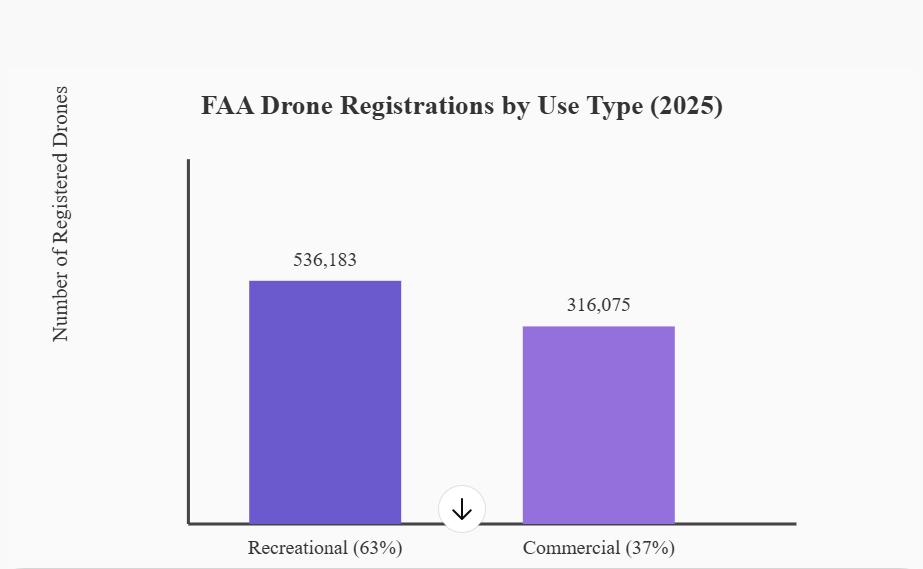
- 63% of drone registrations are for recreational use, while 37% are for commercial purposes.
- Public acceptance remains low, as only 11% of Americans support drones flying near homes.
- 92% of FAA waiver requests are approved for night flight operations, showing regulatory support for controlled expansion.
- Fingers account for 56% of all drone-related injuries, making them the most commonly injured body part.
- About 67% of construction companies use drones for site surveys and progress tracking.
- Medical drone deliveries have helped save 340 lives, especially in rural and remote areas.
- Using drones instead of helicopters can lead to an 87% reduction in carbon emissions for survey work.
- Reforestation drones can plant up to 100,000 trees per day, which is 67 times faster than manual planting.
- 82% of luxury real estate listings above USD 1 million use drone photography to enhance property marketing.
- Drone services generate about USD 840 million annually in the film and media industry.
- The average drone delivery time is 12 minutes, compared with 45 minutes for traditional delivery methods.
- Around 4.5 million households now have access to Walmart’s drone delivery service.
- Infrastructure inspections using drones reduce costs by about 55% compared with traditional inspection methods.
Drone Revenue and Cost Statistics
- The drone industry shows strong economic growth, shaped by global demand, pricing trends, and rising commercial adoption.
- The average drone price in 2024 is USD 540, reflecting wider availability across consumer and professional segments.
- Average revenue per person stands at USD 3.92 in 2024, showing growing individual-level usage worldwide.
- Global drone revenue is expected to reach USD 63.6 billion in 2025, driven by commercial, defense, and service-based applications.
- Annual B2B and government spending is around USD 13 billion, highlighting strong enterprise and public-sector investment in drone technologies.
Top 15 Drone Companies
| Company | Establishment Year | Headquarters | Key Management | Revenue | Headcount | Website |
|---|---|---|---|---|---|---|
| DJI | 2006 | Shenzhen, China | Frank Wang (Founder & CEO) | ~USD 13 billion (2025 est.) | 14,000+ | https://www.dji.com |
| Delair | 2011 | Labège, France | Michaël de Lagarde (CEO) | €28.1 million (FY2024) | 106 | https://delair.aero |
| Aeronavics Ltd. | 2010 | Raglan, New Zealand | Not publicly specified | USD 5.9 million | <25 | https://www.aeronavics.com |
| Autel Robotics | 2014 | Bothell, Washington, USA (R&D Shenzhen, China) | Not publicly specified | USD 128.3 million | 500 | https://www.autelrobotics.com |
| Draganfly Inc. | 1998 | Saskatoon, Canada | Cameron Chell (CEO) | USD 6.55 million (2023) | Not publicly specified | https://draganfly.com |
| EHang | 2014 | Guangzhou, China | Huazhi Hu (Founder & CEO) | USD 47.8 million | 367 | https://www.ehang.com |
| Yuneec International | 1999 | Kunshan, China (HQ Switzerland) | Not publicly specified | USD 545.3 million | 1,758 | https://www.yuneec.com |
| Denel Dynamics | 2000s | Pretoria, South Africa | Not publicly specified | USD 555.3 million | 497 | https://www.denel.co.za |
| Parrot | 1994 | Paris, France | Henri Seydoux (Founder & CEO) | EUR 72 million (2024 est.) | 400+ | https://www.parrot.com |
| Aerovironment Inc. | 1971 | Arlington, Virginia, USA | Wahid Nawabi (CEO) | USD 716.7 million (FY2025) | 1,500+ | https://www.avinc.com |
| Teledyne FLIR LLC | 1978 | Wilsonville, Oregon, USA | David Ray (President) | USD 1.9 billion (FLIR segment) | 4,000+ | https://www.flir.com |
| SenseFly SA (AgEagle) | 2008 | Lausanne, Switzerland | AgEagle executives | N/A | 100+ | https://www.sensefly.com |
| Skydio | 2014 | Redwood City, California, USA | Adam Bry (CEO) | USD 180 million (2024) | 500+ | https://www.skydio.com |
| Wingtra | 2016 | Zurich, Switzerland | Maximilian Boosfeld (CEO) | USD 50 million+ (est.) | 200+ | https://wingtra.com |
| Flyability | 2014 | Lausanne, Switzerland | Patrick Thévoz (CEO) | USD 40 million+ (est.) | 250+ | https://www.flyability.com |
Drone Registrations & Ownership (USA)
- Total registrations: 855,860 drones were registered with the FAA in 2025, showing continued growth in drone usage across the United States.
- Recreational use: 536,183 drones, accounting for 63% of total registrations, are registered for personal and hobby use.
- Commercial use: 316,075 drones, representing 37% of registrations, are used for business and professional applications.
(source: hiredronepilot.uk)
Regional Insights
North America Market Trends
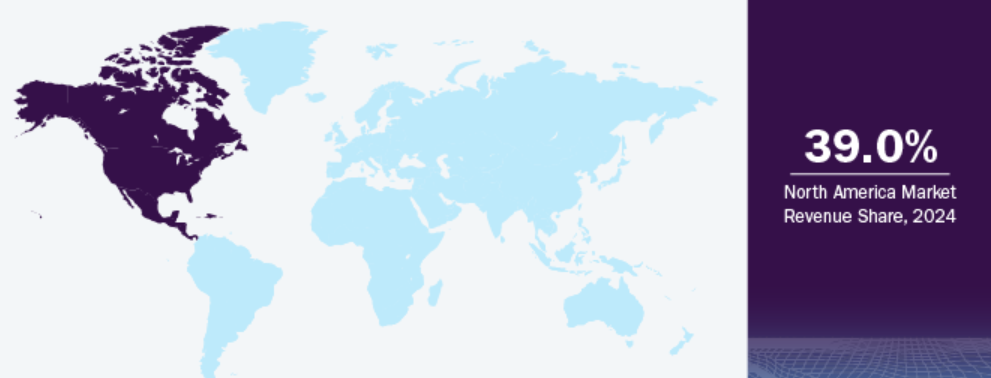
In North America, the drone industry held a leading position in 2024, accounting for over 39% of the global market share. This dominance was driven by the wide use of drones across commercial sectors such as agriculture, construction, and oil and gas operations. Strong technology adoption, early regulatory frameworks, and high investment in drone-based solutions supported market expansion across the region.
U.S. Drone Market Trends
The United States drone market is expected to register a CAGR of around 13% from 2025 to 2030. Growth is supported by increasing use of drones for surveying, inspection, precision farming, and public safety applications. Continued innovation in autonomous flight systems and data analytics is further strengthening market momentum.
Europe Drone Market Trends
The Europe drone industry is projected to grow at a CAGR of over 13% between 2025 and 2030. Rising adoption of drones for infrastructure inspection, environmental monitoring, and defense-related activities is contributing to this growth. Regulatory harmonization across countries is also improving commercial drone operations.
Asia Pacific Drone Market Trends
The Asia Pacific drone market is expected to expand at the fastest CAGR of over 15% from 2025 to 2030. Growth is supported by strong manufacturing capacity, rapid urban development, and rising demand for drones in agriculture, logistics, and surveillance. Increasing government support and investment in drone technology are further accelerating regional market growth.
(source: grandviewresearch.com)
Recent Developments
- In January 2025, SZ DJI Technology Co., Ltd. launched the DJI Flip, a lightweight and foldable drone designed mainly for vloggers and content creators. The drone weighs 249 grams and features a 1/1.3-inch 48MP CMOS sensor, supporting 4K HDR video at 60 fps, slow motion at 100 fps, and SmartPhoto technology for clearer images.
- In January 2025, Pix4D partnered with Freefly Systems to improve drone data workflows. The partnership integrates Pix4D’s photogrammetry software with Freefly’s drone hardware to simplify aerial data capture, processing, and analysis for sectors such as construction, surveying, and agriculture.
- In May 2024, DroneShield introduced DroneSentry C2 Next-Gen v1.00, an advanced command and control system for counter-drone operations. The platform enables centralized monitoring and management of multiple sensors and countermeasures to protect critical infrastructure, public venues, and defense sites from drone threats.
Key Growth Drivers
Technological advances in AI and autonomy enable self-navigating drones for inspections and public safety, boosting enterprise adoption. Regulatory easing, like U.S. bans on Chinese drones, creates opportunities for domestic players such as Skydio and AeroVironment. Precision agriculture and delivery segments project 29% CAGR and $10.5 billion by 2030, respectively.
Rising defense budgets worldwide fuel military drone demand, with AeroVironment projecting $2.6 billion revenue by 2028. Commercial services remain the largest segment at 7.9% CAGR to $57.8 billion overall by 2030. Infrastructure monitoring and logistics efficiencies further accelerate market penetration.
Challenges and Opportunities
Supply chain vulnerabilities and geopolitical tensions challenge dominance by Chinese firms like DJI, prompting diversification to U.S. alternatives. Cybersecurity risks and regulatory compliance add hurdles, especially in sensitive military applications. High initial costs limit small-scale adoption despite falling hardware prices.
Opportunities arise in “drones-as-a-service” projected at $29.4 billion by 2025 and agricultural drones at $22.5 billion by 2030. Expansion into smart cities and eVTOL logistics offers high growth for innovators like EHang and Zipline. Balanced innovation and compliance position top firms for sustained leadership.
Recommended Reading
- DeepSeek Statistics and Latest Facts 2025
- Embedded Finance Statistics: Market Size and Adoption
- Buy Now Pay Later Statistics: Market Size and Usage
- Character.ai Statistics and Facts
- Quick Commerce Statistical Insights and Trends
- AI Statistics, Facts and Investment
Conclusion
Top drone companies continue to shape global market growth through innovation and scale. Their focus on performance, safety, and integration supports wider adoption. Drones are becoming essential tools across multiple industries. This trend is expected to continue steadily. Future growth will depend on autonomy, sensor technology, and regulatory clarity. Companies that align products with industry needs will remain competitive. Service and software integration will gain importance. Overall, the drone market shows strong long-term potential.
Sources:
- https://hiredronepilot.uk/drone-statistics
- https://tracxn.com/d/sectors/drones/__OXaRFvb8e22bXRzPql68ayvrBeJqfgZ2Z7EKgGsCSxE/companies#t-5-anduril
- https://www.grandviewresearch.com/industry-analysis/drone-market-report
- https://market.us/report/drone-market/
- https://www.zoominfo.com/