
Key Takeaways
- Kalshi Research unlocks proprietary data for academics, launching with a study proving 40% better inflation forecasts than Wall Street benchmarks.
- Platform scale is evident in $23 billion total volume and records like $4.4 billion monthly trades, providing rich datasets unmatched elsewhere.
- Partnerships with elite universities and a dedicated conference accelerate validation of prediction markets for policy and finance.
- The move boosts sector legitimacy, potentially influencing regulations and adoption as forecasting alternatives grow.
Overview
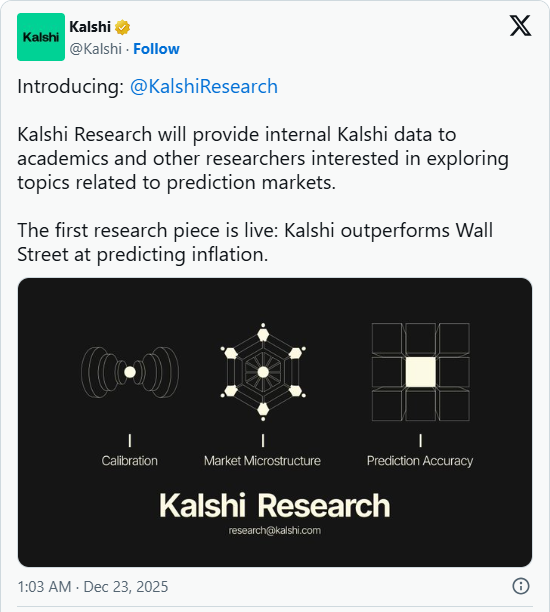
Kalshi, the leading U.S. event trading exchange, announced Kalshi Research on December 22, 2025, to support academic exploration of prediction markets. The new arm grants researchers access to the world’s largest repository of high-quality prediction market data, mirroring research initiatives at firms like OpenAI and Anthropic. This includes anonymized trading volumes, event probabilities, and market behaviors previously limited to platform users.
Kalshi has launched Kalshi Research, a dedicated division providing academics with access to its extensive prediction market data. This initiative includes a debut study showing Kalshi’s inflation forecasts outperform Wall Street by 40% overall. The platform has also amassed over $23 billion in total trading volume since its inception.
The launch coincides with Kalshi hosting the first Prediction Market Conference to unite researchers, traders, and forecasters. Academics from top institutions like Harvard, Stanford, Yale, and the University of Chicago have already committed to projects using this data. Calls for paper abstracts and conference registrations opened immediately to broaden participation.
Purpose of the Initiative
The primary goal behind Kalshi’s decision is to strengthen the academic understanding of event-based trading. Event markets differ from traditional equities or commodities exchanges because they allow participants to trade on the outcomes of real-world events – ranging from macroeconomic indicators to policy decisions. By opening data access, Kalshi seeks to facilitate more scholarly exploration into how such platforms predict future scenarios.
Academic researchers can use this data to analyze how crowds interpret probabilities, adjust to new information, and manage risk. These findings could help refine prediction models used in both the financial and policymaking sectors. Additionally, the partnership model ensures that institutions gain reliable access to structured, anonymized, and ethically sourced trading data.
Key Statistics
Kalshi’s platform has generated total trading volume exceeding $23 billion since June 2021, with daily averages around $14 million recently. A September 2025 analysis showed weekly volumes surpassing $500 million and open interest near $189 million, capturing 62% of the on-chain prediction market sector. October 2025 marked a record with $4.4 billion in trades, outpacing rivals like Polymarket.
The inaugural Kalshi Research study compared inflation forecasts to Wall Street consensus, revealing a 40% accuracy edge across all periods and an 85% win rate one week out. During high-volatility “shock” events, Kalshi’s mean absolute error dropped by 50% compared to traditional forecasts. These metrics underscore the platform’s data depth for academic validation.
Implications for Research and Education
Kalshi’s move has important implications for finance and data science education. Professors and students can now use real-world data to study market efficiency, sentiment dynamics, and quantitative forecasting models. This hands-on access bridges the gap between theoretical learning and practical market analysis, enabling richer research outputs.
For the broader research community, the data could serve as a foundation for cross-disciplinary studies involving economics, psychology, and machine learning. Academic teams can use Kalshi’s datasets to test hypotheses on crowd prediction accuracy or to train AI models that interpret complex probability data. The results may influence how prediction markets are used in future decision-making contexts.
Broader Market Impact
Kalshi’s academic initiative could enhance the public understanding of prediction markets and their societal value. If academic studies validate the effectiveness and reliability of event-based markets, it may encourage more regulatory flexibility and institutional adoption. The collaboration might also attract attention from policymakers, economists, and investors interested in alternative forecasting mechanisms.
With volumes hitting new highs, competitors may follow suit to access similar scholarly partnerships. Insights from studies like the inflation analysis could refine volatility signals for executives and central banks. This positions event markets as vital tools amid economic uncertainty.
Competitive Landscape
Polymarket trails Kalshi in volume but focuses on crypto-native events, while Kalshi dominates regulated fiat trades. Kalshi’s $23 billion total dwarfs many peers, fueled by diverse markets from weather to politics. Academic access differentiates Kalshi as a data leader. Other platforms like PredictIt face volume caps, limiting research potential compared to Kalshi’s scale. Kalshi’s CFTC-regulated status ensures data integrity, appealing to rigorous scholars. This edge may accelerate market share gains in 2026.
Legal challenges
Kalshi faces ongoing legal challenges from state regulators despite federal CFTC approval, particularly over sports event contracts classified as gambling. Recent court rulings in Nevada and Massachusetts highlight tensions between federal preemption and state gambling laws. These disputes could impact operations even as academic data access expands. Kalshi operates under CFTC regulation as a Designated Contract Market, claiming exclusive federal jurisdiction over event contracts.
States like Nevada, New Jersey, Ohio, and Massachusetts argue these resemble unlicensed sports betting, issuing cease-and-desist orders. A November 2025 Nevada ruling dissolved Kalshi’s injunction, subjecting it to state gambling oversight. Multiple lawsuits test preemption under the Commodity Exchange Act, with Kalshi suing regulators in federal courts. Outcomes remain mixed, creating uncertainty for nationwide access. Sports contracts now drive 90% of Kalshi’s volume, amplifying the stakes.
Key Legal Disputes
In Nevada, a U.S. District Court ruled on November 25, 2025, that Kalshi’s sports contracts fall under state gambling laws, rejecting CFTC preemption. The judge found no clear congressional intent to override state authority on wagering. Kalshi plans appeals, citing federal supremacy for derivatives.
Massachusetts Attorney General sued in December 2025, alleging violations like accepting bets from under-21 users without responsible gambling measures. New Jersey saw a temporary injunction favor Kalshi before appeals drew amicus briefs from 34 state AGs. Ohio and Maryland issued similar challenges, leading to preemptive suits.
State vs. Federal Arguments
States assert gambling regulation as a core police power, requiring licenses, age verification, and consumer protections absent in Kalshi’s model. They argue CFTC oversight does not explicitly preempt field or conflict with state laws. Kalshi counters that the CEA grants exclusive federal authority over futures and swaps. Courts examine express, field, and conflict preemption doctrines without CEA’s explicit override clause. New Jersey’s Third Circuit appeal could set precedent, potentially allowing federal bypass of state licensing. Fragmented rulings risk state-by-state compliance burdens.
Conclusion
Kalshi’s launch of Kalshi Research represents a pivotal step in bridging prediction markets with academic inquiry. By granting access to $23 billion in trading data and showcasing superior forecasting accuracy, the platform empowers researchers to validate event-based trading’s real-world value. This initiative not only fosters innovation in economics and AI but also strengthens the sector’s credibility for broader adoption in policy and finance.
Explore More
- Buy Now Pay Later Statistics: Market Size and Usage
- Character.ai Statistics and Facts
- Quick Commerce Statistical Insights and Trends
- AI Statistics, Facts and Investment
- AI Shopping Assistant Statistics
- AI Enabled Robot Picker Insights and Trends