
In 2026, the frequency of cyber attacks continues to rise globally, with research indicating that a cyber attack occurs roughly every 39 seconds, which equates to about 2,200 breaches per day across sectors. This trend reflects persistent exploitation of system vulnerabilities and expanding digital footprints in enterprise environments. Such high-velocity attacks underscore the scale at which threats are operating, outpacing traditional defensive controls.
Key AI Cyber Attack Statistics
- 87% of organizations reported at least one AI powered cyberattack in the past year.
- Phishing attacks increased by 1,265%, largely driven by the use of generative AI tools.
- Around 40% of phishing emails targeting businesses are now AI generated.
- Deepfake based fraud attacks have risen by more than 2,000% since 2022.
- AI generated phishing messages that bypass traditional security filters increased by 25%.
- The average cost of an AI powered data breach reached USD 5.72 million, representing a 13% increase compared with non AI related breaches.
- 68% of reported breaches involve AI driven phishing or social engineering techniques.
- Only 7% of organizations have deployed AI enabled cyber defense tools, despite 88% planning adoption.
- 91% of security professionals expect a significant rise in AI driven cyber threats over the next three years.
- 94% of surveyed professionals identify AI as the most significant driver of change in cybersecurity in the year ahead.
- 68% of cyber threat analysts report that AI generated phishing attempts are harder to detect in 2025 than in any previous year.
- The global average cost of a data breach reached USD 4.88 million in 2024, with AI driven attacks accounting for 16% of all reported cyber incidents.
- Around 64% of organizations are now factoring in geopolitically motivated cyberattacks, including critical infrastructure disruption and espionage.
- The number of AI enabled cyberattacks increased by 47% globally in 2025, indicating rapid escalation in threat activity.
- Financial services emerged as the most targeted industry in 2025, accounting for 33% of all AI driven cyber incidents.
- Ransomware activity continues to intensify, with forecasts indicating a 40% rise in publicly named victims, increasing from 5,010 in 2024 to over 7,000 by 2026.
- Synthetic media attacks, including deepfakes, grew by 62% year over year in 2025, with most incidents targeting enterprise identity verification systems.
- North America recorded the highest regional increase in AI related breaches, with a 39% year over year rise in 2025.
AI-Driven Attack Adoption and Impact
A very high proportion of organisations now report direct encounters with AI-enhanced attacks. Surveys show that up to 87% of global businesses have experienced an AI-driven cyberattack within the past year, highlighting how quickly malicious actors have adopted machine learning and automation to amplify attack sophistication. These attacks often combine multiple communication channels and personalised content to evade detection.
Organisations are widely adjusting security strategies, with recent global data showing that 77% of companies have implemented AI tools for defensive purposes such as phishing detection and anomaly response. This reflects both the defensive and offensive roles AI plays in the threat landscape.
Vulnerabilities and AI Systems at Risk
Recent surveys indicate severe weaknesses in enterprise AI security posture. One report found that 90% of enterprise AI systems could be compromised within 90 minutes during adversarial testing, with some systems breached in a matter of seconds. This rapid compromise reflects both attack sophistication and gaps in protective architectures.
AI prompt-related risks have also risen, with risky AI prompts increasing by nearly 97% in 2025, and a substantial share of analysed model context protocols showing vulnerabilities. These trends suggest that as organisations adopt AI more extensively, the attack surface expands in tandem.
AI in Phishing and Malware Campaigns
Industry reports note that a large majority of phishing campaigns now incorporate AI elements to personalise messages and evade filters. Autonomous attack vectors use machine learning algorithms to customise email and social engineering content and orchestrate multi-stage attacks without direct human intervention. FAKE accounts, deepfakes, and synthetic identities have become tools in highly targeted enterprise scams, increasing the effectiveness of these campaigns.
Infrastructure and Critical Incidents
High-profile incidents continue to illustrate the real-world impact of cyber threats, including attacks on healthcare infrastructure that disrupted operations and critical services. In one case, a major hospital network in Belgium suffered a system outage due to a cyberattack, affecting surgical schedules and emergency services.
Distributed denial of service attacks have reached historic levels, with one monitoring service recording a peak traffic volume of more than 31 terabits per second in late 2025, a figure that reflects both the volume and intensity of modern botnet operations.
Industry Risk Perspectives
AI is increasingly recognised as a central factor in future cyber risk assessments. Industry forecast reports highlight that AI-enabled threats are reshaping the attack landscape, creating novel vulnerabilities that traditional security controls are not prepared to fully address. As AI adoption grows in enterprise operations, the pressure on security strategy at organisational leadership levels has intensified.
Dual Use of AI in Cybersecurity
While attackers leverage AI to scale and automate attacks, defenders also increasingly use AI to enhance threat detection, behavioural analytics, and incident response. This arms-race dynamic results in both heightened risk and improved security technologies, driving rapid evolution in defensive practices.
AI in Cybersecurity Market Size
Key Takeaways
- The AI in cybersecurity market is projected to reach approximately USD 163 billion by 2033, expanding at a 22.3% CAGR, reflecting the growing role of AI in managing complex cyber threats.
- In 2023, the services segment led the market with more than 35% share, driven by demand for managed security, consulting, and integration support.
- The network security segment captured over 38% share in 2023, supported by rising attacks on enterprise networks and cloud infrastructure.
- Machine learning (ML) dominated technology adoption with more than 47% share, as ML models remain central to threat detection and anomaly analysis.
- The fraud detection and anti fraud segment accounted for over 20%, reflecting strong use of AI to identify financial crime and suspicious transactions.
- The BFSI sector led end user adoption with more than 28% share, driven by high exposure to cyber risks and strict regulatory requirements.
- North America held over 36% of the global market in 2023, supported by advanced security infrastructure and early AI adoption.
- 55% of companies globally plan to use AI to strengthen corporate cybersecurity in 2024.
- 21% of IT decision makers believe AI can support the creation and optimization of security rules.
- 19% of respondents expect attack simulation and compliance monitoring to be key AI use cases in cybersecurity during 2024.
- 63% of security professionals believe AI can improve threat detection and response effectiveness.
- Only 12% of security professionals expect AI to fully replace their roles, indicating confidence in human oversight.
- 30% expect AI to enhance their skills, while 28% view AI as a general support tool in daily security operations.
- 24% anticipate AI will automate large portions of their responsibilities, allowing focus on higher value tasks.
- C suite executives report higher familiarity with AI at 52%, compared with 11% among staff, highlighting a knowledge gap.
- More than 55% of organizations plan to implement generative AI solutions in 2024, signaling accelerated AI adoption across the cybersecurity sector.
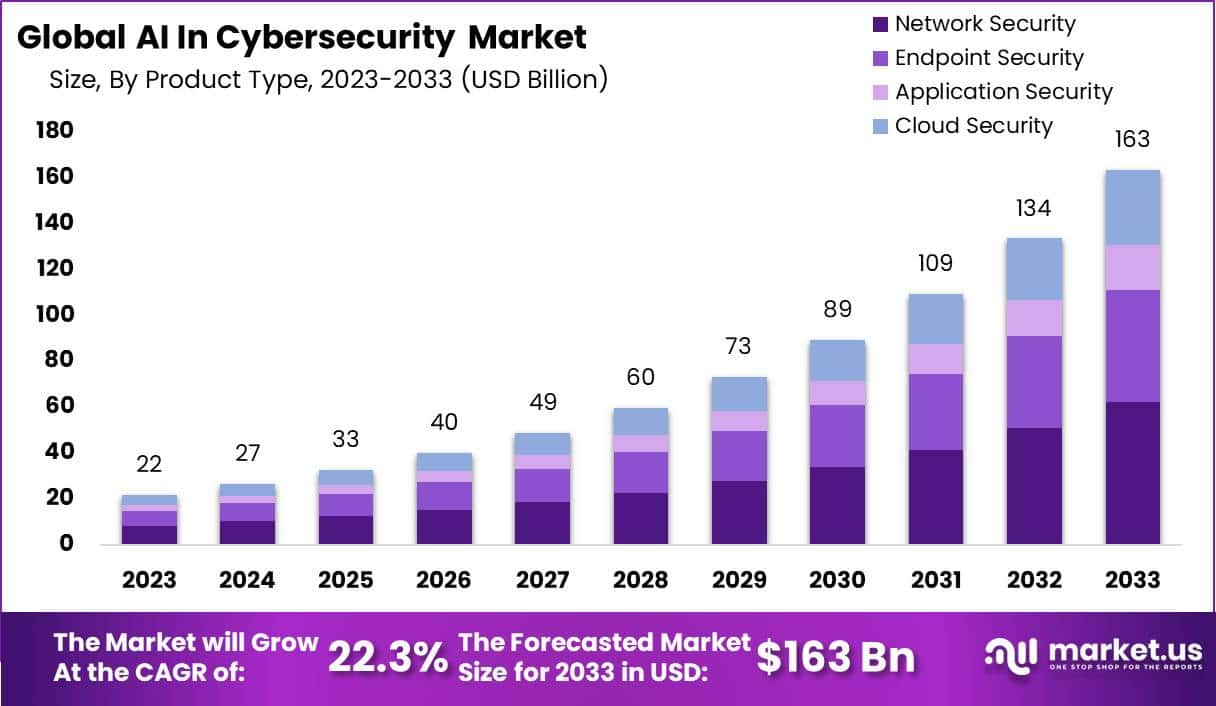
(source: market.us)
Drivers Impact Analysis
| Key Driver | Impact on CAGR Forecast (~)% | Geographic Relevance | Impact Timeline |
|---|---|---|---|
| Rapid increase in cyberattacks and sophisticated threat vectors | +6.1% | Global | Short to medium term |
| Growing adoption of AI for real-time threat detection and response | +5.4% | North America, Europe | Medium term |
| Expansion of cloud computing and remote work environments | +4.6% | Global | Medium term |
| Rising regulatory pressure for data protection and compliance | +3.7% | Europe, North America | Medium to long term |
| Shortage of skilled cybersecurity professionals | +2.5% | Global | Long term |
The combined driver impact strongly supports the ~22.3% CAGR, with threat complexity and automation needs acting as the primary growth catalysts.
Restraints Impact Analysis
| Key Restraint | Impact on CAGR Forecast (~)% | Geographic Relevance | Impact Timeline |
|---|---|---|---|
| High implementation and integration costs of AI-based solutions | −3.6% | Emerging Markets | Short to medium term |
| Data quality and model training limitations | −2.9% | Global | Medium term |
| Lack of trust in fully automated security decision systems | −2.4% | Europe, Asia Pacific | Medium term |
| Complexity in integrating AI tools with legacy IT infrastructure | −2.1% | Global | Medium term |
| Regulatory uncertainty around AI decision transparency | −1.7% | Europe | Medium to long term |
Cyberattack Exposure Across Industries Key Insights
- Financial services account for nearly 33% of reported AI-enabled cyber incidents due to high-value transactions and sensitive customer data
- Healthcare remains a major target as digitized patient records and connected medical systems increase attack surfaces
- E-commerce platforms face rising credential theft and payment fraud as online transactions continue to expand
- Critical infrastructure and utilities are increasingly targeted due to legacy systems and growing IT-OT integration
- Cyberattacks occur approximately every 39 seconds, equating to over 2,200 incidents per day globally
- India recorded more than 265 million cyberattack attempts in 2025, reflecting rapid digital expansion risks
- Around 87% of organizations globally report experiencing at least one AI-driven cyberattack in the last year
Common AI Enabled Cyberattack Techniques Insights
- Over 80% of phishing emails in 2025 are estimated to include AI-generated or AI-assisted content
- AI-powered phishing campaigns use natural language models to create personalized and context-aware messages
- Deepfake-based impersonation attacks increased by more than 680% year over year
- At least 179 confirmed deepfake fraud incidents were reported in early 2025
- Voice-based deepfake scams surged by over 1,600%, driven by accessible voice cloning tools
- AI-driven malware increasingly adapts its code behavior to evade signature-based detection systems
- Automated credential stuffing and vulnerability scanning are now frequently supported by machine learning models
Generative AI Impact on Phishing and Deepfake Attacks Insights
- AI-generated phishing messages show significantly higher engagement than traditional phishing emails
- Generative AI enables attackers to replicate corporate tone, writing style, and timing with high accuracy
- Multi-step fraud campaigns increasingly combine AI-generated emails with deepfake voice confirmation calls
- Less than 50% of individuals can reliably distinguish AI-generated phishing from legitimate communication
- Deepfake technology is increasingly used to impersonate executives and trusted vendors
- Cybersecurity leaders rank generative AI-driven deception among the least prepared-for threats entering 2026
- The use of generative AI has increased both the scale and success rate of social engineering attacks
Top 10 Cybersecurity Trends of 2026
1. AI-Driven Attacks and Defenses
In 2026, artificial intelligence technology continues to shape cyber risk as a dual-use force. Threat actors are leveraging AI to automate vulnerability discovery, execute tailored phishing campaigns, and adapt exploits without human direction, increasing the speed and scale of attacks.
Simultaneously, defenders are adopting AI-enhanced systems for threat detection, automated response, and incident prioritization, reducing manual workload and improving threat visibility. The convergence of offensive and defensive AI dynamics means organizations must employ robust governance structures to manage both sides of the threat and protection cycle.
2. Identity-Centric Risks and Zero Trust Expansion
Identity continues to be one of the most targeted attack surfaces in 2026, driven by credential theft, account takeover, and AI-assisted impersonation attacks. Security frameworks now emphasize Zero Trust principles, where verification of every access request becomes standard practice rather than exception.
Continuous access validation, microsegmentation, and adaptive authentication models are being widely adopted to limit lateral movement and reduce exposure from compromised credentials. This trend reflects a shift from perimeter protection to identity-centric security, which is becoming foundational for modern cybersecurity strategies.
3. Supply Chain Vulnerability and Third-Party Risk
Cyber threats in 2026 are increasingly focused on supply chain and software dependencies, where a single compromised vendor or update can impact entire ecosystems. Attackers are targeting managed service providers, cloud platforms, and trusted libraries to propagate malicious code widely and rapidly.
Organizations are therefore prioritizing deeper scrutiny of third-party risk, continuous monitoring of vendor activity, and secure software delivery practices to reduce cascading impacts from indirect breaches. This trend highlights the interconnected nature of modern digital infrastructures and the need for rigorous supply chain oversight.
4. Ransomware Evolution and Extortion Tactics
Ransomware attacks in 2026 have evolved beyond simple encryption to include data theft, double extortion, and multi-stage extortion strategies that target business continuity and reputation. Attackers not only hold data hostage but also threaten disclosure or leverage compliance and regulatory pressure to coerce victims.
Organizations are responding with layered defenses, segmentation strategies, and proactive incident recovery planning to mitigate both technical and financial impacts. The complexity and reach of modern ransomware campaigns underline the need for strategic resilience measures.
5. Regulatory Shifts and Security Governance
Cybersecurity in 2026 is shaped by expanding regulatory requirements that influence disclosure practices, data protection standards, and AI governance frameworks. New rules are emerging to raise the bar on incident reporting timelines, consent mechanisms, and cross-border data flows, especially for sensitive sectors like financial services and healthcare.
As compliance becomes more complex and globally diverse, organizations are investing in security governance and risk management programs that align technical controls with evolving legal obligations. This trend emphasizes the growing intersection between legal frameworks and cybersecurity strategy.
6. Operational Technology and Critical Infrastructure Exposure
Operational technology (OT) environments, including industrial systems, utilities, and transportation networks, remain a critical cybersecurity concern in 2026. Legacy systems, remote connectivity, and IT-OT convergence create vulnerability pathways that adversaries can exploit to disrupt physical processes and public services.
Security strategies now emphasize visibility into OT networks, behavioral monitoring, and prioritized risk alerts to strengthen continuity and safety. This focus on OT security reflects the high stakes of protecting infrastructure that underpins economic and social function.
7. Privacy, Data Sovereignty, and Governance Integration
Data privacy and sovereignty concerns are influencing cybersecurity priorities as organizations operate globally under diverse regulatory environments. Cross-border data transfer restrictions, data residency requirements, and third-party oversight are shaping security investments and governance programs.
Strong privacy frameworks are now viewed as both compliance necessities and trust enablers, supporting secure AI adoption and customer confidence. Security teams are thus integrating privacy considerations into their risk assessment and control frameworks rather than treating them as separate domains.
8. Workforce and Skills Landscape Transformation
The cybersecurity professional landscape in 2026 reflects persistent skills shortages and evolving role requirements. Organizations increasingly value specialists in AI security, identity management, cloud defense, and threat hunting to address sophisticated risks.
At the same time, AI-assisted security tools are helping compensate for talent gaps by automating routine detection and response tasks, enabling human analysts to focus on complex threat analysis. This blending of human expertise with advanced tooling underscores the transformation of workforce strategies in cybersecurity operations.
9. Quantum Computing and Cryptographic Resilience
Emerging advances in quantum computing are prompting forward-looking cybersecurity initiatives focused on cryptographic resilience. Traditional encryption methods face long-term risk from quantum-capable processors, and organizations are exploring post-quantum cryptography frameworks to prepare for future threats.
While practical quantum attacks are still emerging, 2026 marks a period where proactive planning, migration roadmaps, and expertise expansion become strategic priorities. This trend represents a shift from reactive incident response to anticipatory security planning.
10. Cyber Resilience and Business Continuity Emphasis
Finally, cybersecurity in 2026 increasingly emphasizes resilience beyond threat prevention, with strategic focus on detection, containment, response, and recovery capabilities. Organizations are integrating cyber resilience metrics into executive governance and demonstrating how security strategies support broader continuity goals.
Incident response readiness, tabletop exercises, and automated detection pipelines are being enhanced to reduce impact and downtime from inevitable breaches. This trend moves cybersecurity from a technical cost center toward a strategic enabler of operational sustainability and trust.
You may also like to read
- Digital Banking Statistics: By Market, Usage and Security Insights
- Creator Economy Statistics and Insight
- Cybersecurity Statistics : Facts And Figures
- EdTech Statistics: Redefining Education in the Digital Age
Summary
In summary, AI-related cyber attack statistics for 2026 show a landscape with sharply rising risk recognition, increased attack automation, rapid exploitation timelines, new social engineering capabilities, and dual-use technology cycles where defenders need equally advanced tools and governance to manage exposure. These trends underscore the need for integrated security strategies that combine AI-augmented defence, robust policy controls, and continuous risk assessment.
Sources
- https://sqmagazine.co.uk/ai-cyber-attacks-statistics/
- https://www.allaboutai.com/resources/ai-statistics/ai-cyberattack/
- https://cybersecuritynews.com/cybersecurity-predictions-2026/
- https://market.us/report/ai-in-cybersecurity-market/
- https://www.sentinelone.com/cybersecurity-101/cybersecurity/cyber-security-statistics/
- https://sosafe-awareness.com/company/press/global-businesses-face-escalating-ai-risk-as-87-hit-by-ai-cyberattacks/
- https://programs.com/resources/ai-cyberattack-stats/
- https://keepnetlabs.com/blog/deepfake-statistics-and-trends
- https://ir.zscaler.com/news-releases/news-release-details/zscaler-threatlabz-uncovers-surge-ai-driven-cyberattacks
- https://thenetworkinstallers.com/blog/ai-cyber-threat-statistics/
- https://www.vikingcloud.com/blog/cybersecurity-statistics
- https://www.weforum.org/publications/global-cybersecurity-outlook-2026/
- https://www.itpro.com/security/cyber-attacks/credential-theft-has-surged-160-percent-in-2025
- https://www.eccu.edu/blog/cybersecurity-trends-2026/