
Quick Commerce Statistical Insights: Quick commerce is a new type of online retail model that focuses on delivering small, essential orders to customers in a very short time, usually within 10 to 60 minutes of placing the order. It sits between traditional e commerce and food delivery, targeting urgent and everyday needs like groceries, snacks, medicines and basic household items, mostly in dense urban areas where customers value speed more than variety.
Quick Commerce Overview
Statistics: Key Highlights
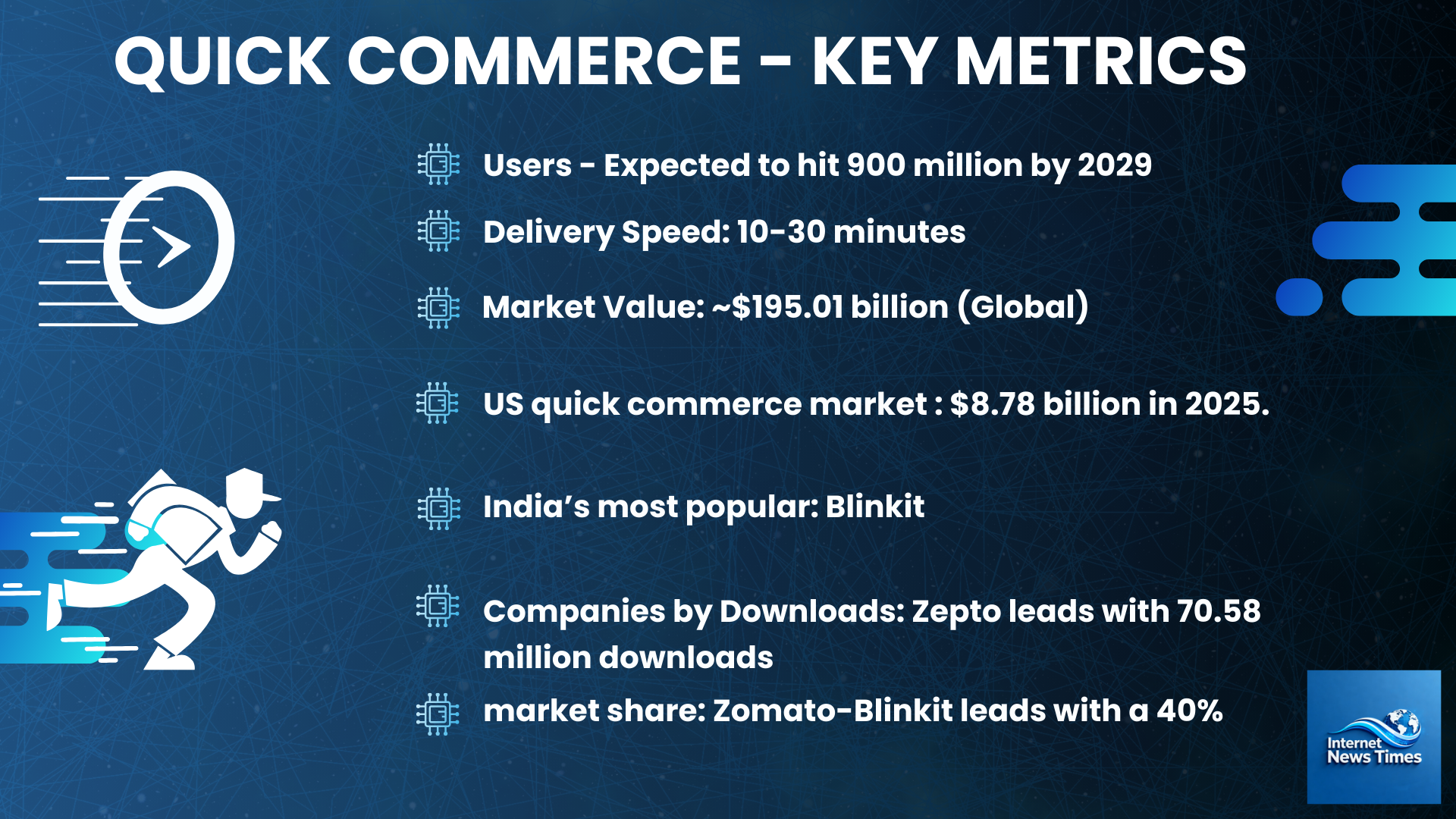
- According to fortune business insights, quick commerce market was valued at USD 170.80 billion in 2024 and is expected to show steady growth in the coming years. The market is forecast to rise from USD 184.55 billion in 2025 to nearly USD 337.59 billion by 2032, growing at an annual rate of 9.01% during this period.
- North America held the largest share of the market in 2024, accounting for 33.52% of total revenue.
- The competitive landscape remains intense, led by well-known platforms such as Getir, Blinkit, GoPuff, Flink, and Swiggy Instamart.
- Global quick commerce deliveries now average just 10–30 minutes, setting a new benchmark for instant retail fulfillment.
- India leads global growth with a rapid 17% expansion rate, driven by dense urban demand and high mobile commerce adoption.
- Blinkit dominates the Indian market with a 45% to 46% share, making it the clear category leader.
- Zepto holds 29% share, showing strong competitive positioning in ultra-fast grocery delivery.
- Swiggy Instamart controls 25% share, supported by its integration with food delivery demand.
- The U.S. quick commerce market is projected to reach USD 8.78 billion in 2025, reflecting rising demand for instant convenience.
- Nearly 77% of customers now expect delivery within two hours, pushing platforms toward faster fulfillment models.
- Zomato invested ₹1,500 crore into Blinkit to expand dark store coverage and strengthen last-mile speed.
- Flipkart committed ₹3,249 crore to scale its Minutes network for rapid deliveries.
- Reliance Retail achieved 2.4x order growth using sub-30-minute delivery across 4,000 pin codes.
- Around 6,000 dark stores are currently operating worldwide, forming the backbone of quick commerce logistics.
- In the United States, roughly 200 dark stores support fast-delivery operations, showing the market is still at an early scale compared to India.
Quick Commerce Market Size
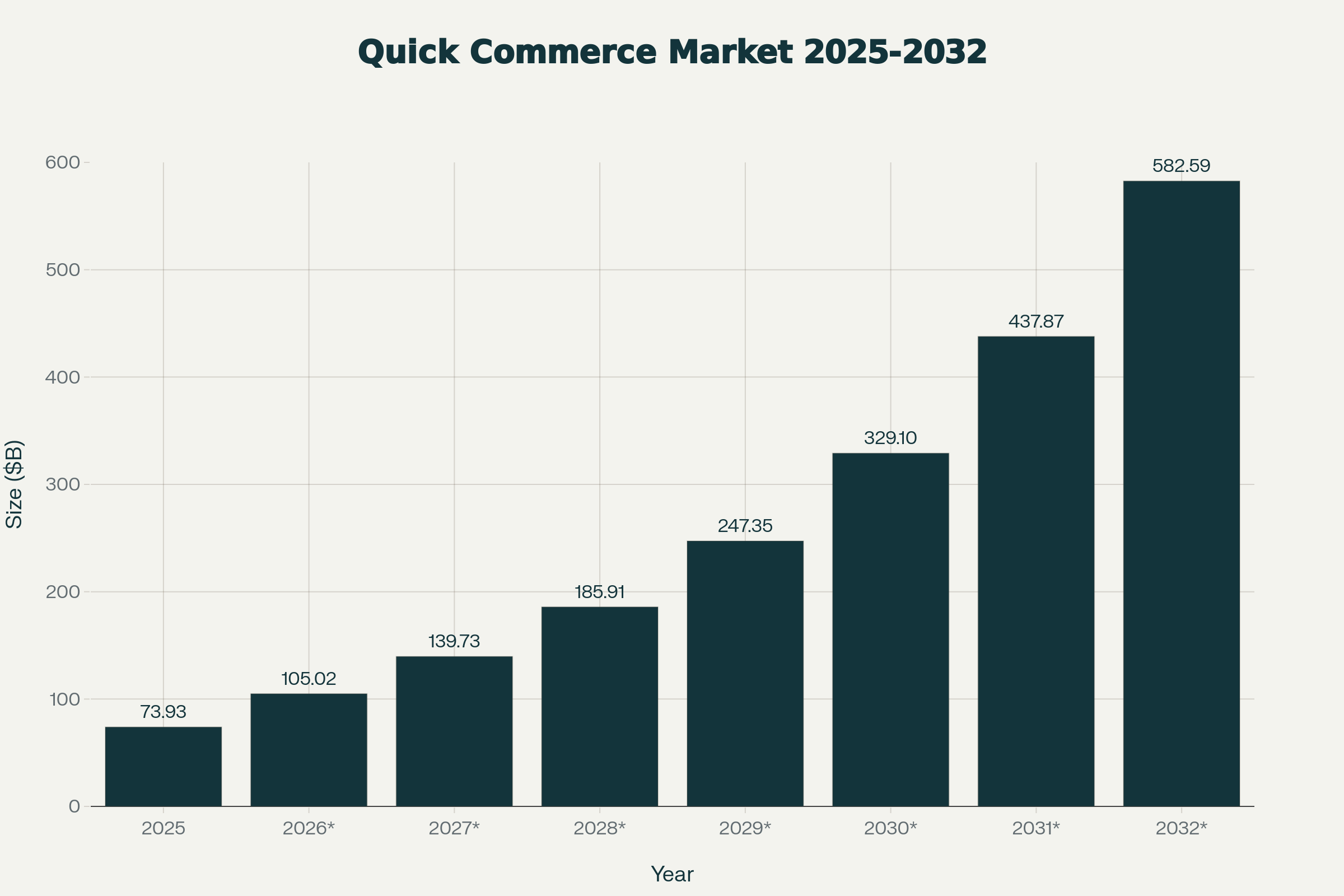
Forecasted Growth Overview
| Year | Market Size (Billion USD) |
|---|---|
| 2025 | 73.93 |
| 2026* | 105.02 |
| 2027* | 139.73 |
| 2028* | 185.91 |
| 2029* | 247.35 |
| 2030* | 329.10 |
| 2031* | 437.87 |
| 2032* | 582.59 |
(source: demandsage)
Recent Developments
- May 2025: Zomato invested ₹1,500 crore or USD 180 million into Blinkit to expand its dark store footprint to 2,000 locations by December, strengthening ultra-fast delivery coverage.
- May 2025: Flipkart allocated ₹3,249 crore or USD 382 million to scale its Minutes quick delivery network to 800 active nodes within the year, signaling aggressive market expansion.
- April 2025: Reliance Retail reported 2.4x order growth and announced sub-30-minute delivery across 4,000 pin codes, reflecting strong customer response to speed-led fulfillment.
- April 2025: Flipkart activated 200 new dark stores to deepen urban penetration and improve last-mile efficiency in high-demand city clusters.
Revenue Statistics
Different countries wise
| Year | India | China | USA | Japan | South Korea |
|---|---|---|---|---|---|
| 2022 | $0.58 billion | $52.76 billion | $39.89 billion | $2.69 billion | $2.07 billion |
| 2023 | $1.58 billion | $67.29 billion | $47.92 billion | $3.21 billion | $2.47 billion |
| 2024 | $3.35 billion | $80.84 billion | $56.52 billion | $3.77 billion | $2.85 billion |
| 2025 | $5.38 billion | $92.68 billion | $62.63 billion | $4.31 billion | $3.19 billion |
| 2026 | $6.94 billion | $102.60 billion | $68.35 billion | $4.80 billion | $3.46 billion |
Quick Commerce vs. E-commerce
| Dimension | Quick Commerce (Q-commerce) | Traditional E-commerce |
|---|---|---|
| Core Promise | Ultra-fast delivery of essentials, usually within 10 to 30 minutes in a limited radius. | Delivery in 1 to 3 days or more, with options for scheduled or standard shipping. |
| Typical Products | Groceries, FMCG, personal care, OTC medicines, small daily-use items. | Very broad mix including electronics, fashion, home goods, and niche long-tail items. |
| Assortment Size | Curated range of roughly 1,000 to 5,000 fast-moving SKUs per dark store. | Can scale into hundreds of thousands or even millions of SKUs across categories. |
| Fulfilment Model | Hyperlocal dark stores or micro-warehouses close to customers with high store density. | Large centralized or regional warehouses serving wide geographies. |
| Delivery Radius | Usually 2 to 5 km around each dark store, focused on dense urban pockets. | Citywide, nationwide, or cross-border depending on the platform. |
| Order Size and Frequency | Smaller average basket values but higher order frequency per user. | Higher basket values with lower order frequency and more planned purchases. |
| Pricing and Fees | Often higher markups and explicit delivery fees to cover speed and last-mile costs. | Competes heavily on price with many free or low-fee shipping options. |
| Cost Structure | Higher per-order logistics and labor costs due to decentralized instant fulfilment. | Lower per-order costs through scale, automation, and consolidated shipping. |
| Profit Model | Relies on frequent orders, delivery fees, and advertising, with profitability still emerging. | Relies on scale, marketplace commissions, advertising, and subscription programs. |
| Typical Users / Missions | Time-poor urban customers needing urgent top-ups and impulse purchases. | Wide customer base buying both essentials and discretionary items with planning. |
| Geographic Focus | Strongest in dense metros, gradually expanding into tier-2 cities. | Penetrated across metros, small cities, and rural regions in many countries. |
| Growth Trajectory | Smaller base but very high growth rate and fast user adoption. | Large, mature market growing at mid to high single-digit rates globally. |
India Quick Commerce
Adoption and Users
- India recorded about 26.2 million quick commerce users in 2024, and this base is expected to reach 60.6 million by 2029, showing strong mass adoption momentum.
- Awareness is extremely high at 91% among Indian internet users, indicating near-universal familiarity with quick commerce services.
- More than 50% of surveyed users had used a quick commerce app in the week before the survey, reflecting high repeat usage.
- Growth is being driven by high smartphone penetration, low data costs, and fast urban expansion across Indian cities.
Usage Statistics
- In urban India, 39% of users order 2–3 times a month, while 34% place orders monthly, showing steady demand cycles.
- Quick commerce now accounts for nearly two-thirds of all online grocery orders in India, making it the dominant digital grocery channel.
- About 75% of shoppers make unplanned purchases on these platforms, confirming strong impulse-driven buying behavior.
- Nearly 45% of festive shopping in 2025 took place on quick commerce apps, showing their growing role in seasonal demand.
- Beyond groceries, fashion accessories, beauty, and health products are emerging as fast-growing categories.
Demographics
- Millennials and Gen Z form the core user base, with the 25–34 age group leading usage on platforms like Blinkit and Zepto, followed by users aged 18–24.
- Male users form the majority at around 62–64%, though the female user base continues to expand steadily.
- In urban India, 33% of users earn between ₹20,000–₹40,000 per month, while 28% earn above ₹40,000, reflecting strong participation from middle- and upper-income groups.
- Tier 1 cities still hold the largest market share, but Tier 2 and Tier 3 cities are now showing the fastest growth in new user adoption.
Key Players in India
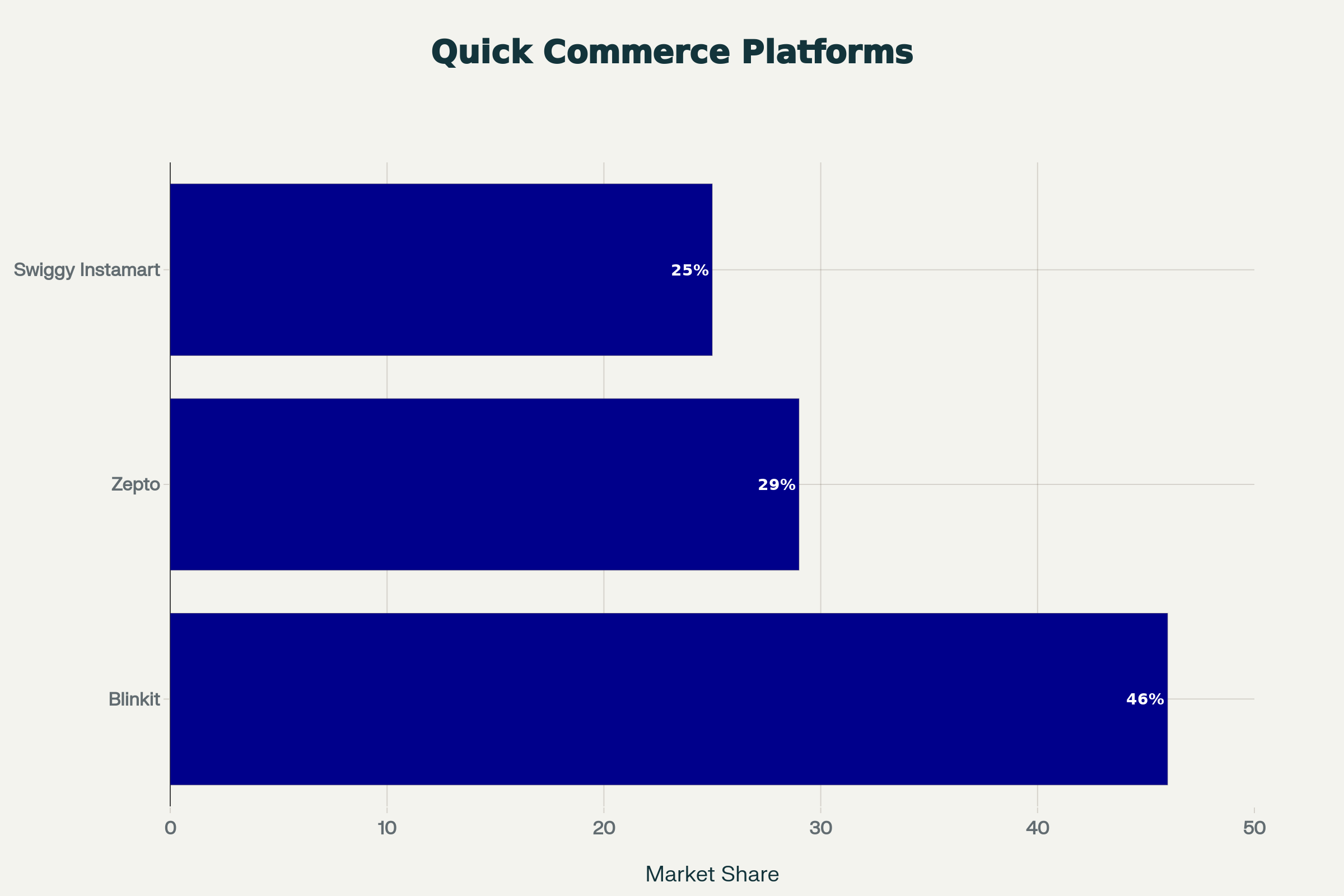
- Blinkit leads the Indian quick commerce market with a 46% share, confirming its strongest position across metro and tier-one cities.
- Zepto holds 29% share, supported by aggressive expansion, private labels, and high user retention in dense urban clusters.
- Swiggy Instamart controls 25% share, leveraging its food delivery base to drive repeat grocery ordering.
- Zepto’s revenue surged from ₹140 crore in FY22 to nearly ₹5,000 crore in FY24, showing rapid scale-up within a short period.
- Swiggy Instamart’s Gross Order Value grew 58% YoY to around ₹8,100 crore, reflecting rising order frequency and basket size.
- Zomato invested ₹1,500 crore into Blinkit to expand its dark store network and strengthen fulfillment speed.
- Flipkart committed ₹3,249 crore to scale its Minutes network, signaling serious long-term focus on ultra-fast delivery.
- Reliance Retail achieved 2.4x order growth with sub-30-minute delivery across 4,000 pin codes, showing the impact of speed-led retail strategy.
(Source: meetanshi)
Emerging Trends
| Trend | Description |
|---|---|
| AI and Tech Optimization | Platforms use AI for route planning, demand prediction, and inventory control to cut delivery times and boost efficiency. |
| Product Range Expansion | Services now offer more than groceries, including electronics, beauty items, toys, and appliances for instant needs. |
| Sustainability Push | Electric vehicles and drones gain traction for greener last-mile delivery, meeting consumer demand for eco-friendly options. |
| Tier-2/3 City Growth | Expansion beyond metros targets smaller cities, though lower density poses economic challenges for operators. |
| Retail Media and Ads | Sponsored product listings and brand promotions inside apps grow fast, creating new revenue from advertising. |
Future Outlook
The future of quick commerce depends on cost control, automation, and stronger private label penetration. Technology driven fulfillment and demand forecasting will play a larger role in improving margins. Expansion into new product categories such as electronics accessories and healthcare supplies is also expected. Partnerships with local manufacturers may improve supply stability and reduce input costs.
Conclusion
Quick commerce has reshaped last mile retail by introducing instant delivery as a standard expectation in urban markets. The model meets strong consumer demand for speed and convenience but also carries heavy cost structures. Long term success will depend on operational efficiency, disciplined expansion, and improved unit economics. Platforms that balance speed with sustainable profits are likely to remain stable in the evolving digital retail ecosystem.
Explore More Statistics
- eSports Statistics -By Market Size, Viewers and Demographics
- DeepSeek Statistics and Latest Facts 2025
- Embedded Finance Statistics: Market Size and Adoption
- Buy Now Pay Later Statistics: Market Size and Usage
- Character.ai Statistics and Facts
Sources:
- https://meetanshi.com/blog/quick-commerce-statistics/https://www.demandsage.com/quick-commerce-statistics/
- hhttps://binmile.com/blog/quick-commerce-vs-e-commerce/
- hhttps://deonde.co/blog/quick-commerce-vs-e-commerce/
- hhttps://unicommerce.com/blog/what-is-q-commerce-india-trends-models-challenges/
- hhttps://www.fortunebusinessinsights.com/quick-commerce-market-111868
- hhttps://www.shoptrial.co/quick-commerce-statistics/
- hhttps://www.fynd.com/blog/quick-commerce-market-share-india
- hhttps://www.grabon.in/indulge/tech/quick-commerce-statistics/
- hhttps://www.mordorintelligence.com/industry-reports/q-commerce-industry-in-india
- hhttps://www.bloggersideas.com/quick-commerce-statistics/