

Italy’s antitrust authority has fined Apple approximately $116 million for alleged abuse of its dominant position in the mobile app market through its App Tracking Transparency (ATT) feature. Apple’s ATT policy requires apps to obtain user consent before tracking for personalized ads, but regulators claim it imposes unfair burdens on developers. Apple plans to appeal the decision, defending the feature as essential for user privacy.
Key Takeaways
- AGCM fined Apple €98.6 million ($116M) for ATT’s alleged anti-competitive effects on App Store developers.
- ATT requires user opt-in for cross-app tracking, reducing ad personalization but sparking developer backlash over revenue losses.
- Apple will appeal, prioritizing user privacy amid EU-wide antitrust challenges.
- Global App Store activity hit $1.3T in 2024; Italy’s app market projects steady growth.
- Apple plans appeals amid similar penalties in France, underscoring EU antitrust pressure.
- Developers face ongoing challenges balancing user opt-ins with monetization needs.
Incident Overview
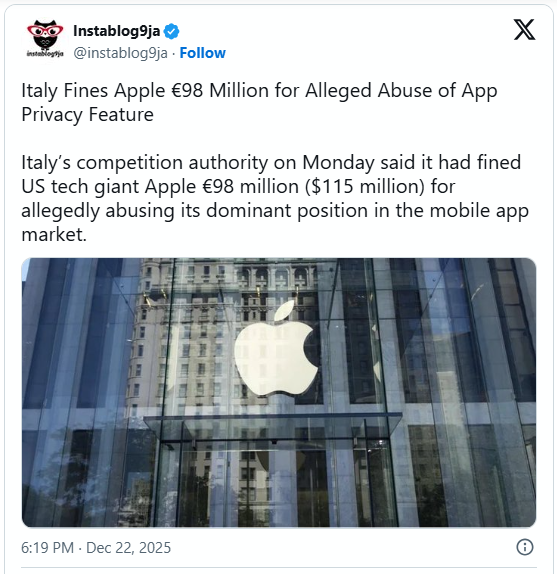
Italy’s competition authority, known as AGCM, imposed a fine of 98.6 million euros on Apple and two subsidiaries on December 22, 2025. The penalty targets Apple’s control over the App Store, where it holds significant dominance in dealings with third-party developers. This action stems from an investigation coordinated with the European Commission and Italy’s data protection authority.
Regulators argue that ATT creates disproportionate barriers for external developers compared to Apple’s own apps. Developers face stricter consent rules, often requiring duplicate permissions for data use, which harms their ad-based business models. The authority views these terms as unilateral and not aligned with standard privacy laws.
Regulatory Background
Italy’s AGCM launched the probe in 2024 amid broader EU efforts to curb Big Tech dominance. The investigation focused on how ATT affects app developers who rely on ad revenue for survival. This fine follows similar actions against Apple in France and the Netherlands over similar App Store policies. European watchdogs coordinate closely on these cases to ensure consistent enforcement across borders. Apple’s iOS commands a loyal user base, but Android holds over 70% market share in Italy. Such probes aim to level the field for smaller players in the app economy.
Reasons for the Fine
The core issue lies with ATT, introduced in iOS 14.5 in 2021, which prompts users for tracking permission before apps collect data for targeted advertising. Italian regulators contend that Apple’s implementation exceeds necessary privacy protections and stifles competition by limiting developers’ access to user data. They highlight that Apple’s native apps operate under lighter restrictions, giving the company an unfair edge.
Authorities noted that the policy forces developers to seek consent multiple times for similar purposes, reducing efficiency and revenue potential from ads. This setup disadvantages smaller apps reliant on advertising while benefiting Apple’s ecosystem. The fine reflects concerns over Apple’s absolute control in app distribution and payments.
Apple’s Position
Apple strongly disagrees with the ruling, stating it overlooks the privacy benefits of ATT for iPhone users. The company argues the feature prevents unauthorized data sharing by ad tech firms and data brokers. Apple has announced plans to appeal in Italian courts to challenge the antitrust findings.
In defense, Apple emphasizes ATT’s role in empowering users with choice over personal data. The policy aligns with broader privacy commitments, including compliance with EU regulations. This marks another clash between Apple’s privacy stance and European regulators’ competition priorities.
Developer Impact
ATT prompts users to approve tracking before apps share data across devices for targeted ads. Many developers report revenue drops of 20-40% after iOS 14.5 rollout due to lower opt-in rates around 25-30%. This forces them to rethink business models away from personalized advertising. Smaller Italian studios feel the pinch hardest as they lack resources for alternatives like contextual ads. Larger firms adapt faster with first-party data strategies. The policy shifts power toward platforms that control user relationships directly.
Broader Context
This fine adds to ongoing EU scrutiny of Apple, including probes into App Store fees up to 30% and restrictions on alternative payments. Italy’s iOS market share hovers around 25-30%, with Android leading at nearly 75% as of recent data. Apple’s global App Store generated nearly $1.3 trillion in billings and sales in 2024, underscoring its economic weight.
ATT has reshaped mobile advertising, dropping tracking consent rates from 74% pre-ATT to about 17% post-implementation in studied cases. In Italy, app revenues remain robust, with gaming apps topping charts despite policy shifts. Such rulings signal intensifying pressure on tech giants to balance privacy with open markets.
Conclusion
Italy’s antitrust fine against Apple underscores the growing clash between robust privacy protections and fair competition in the app economy. As regulators push for balanced rules, Apple faces pressure to refine features like ATT without compromising user safeguards. This case, alongside broader EU actions, signals a pivotal moment where tech giants must adapt to evolving digital market standards, potentially reshaping app distribution and revenue models across Europe.
Read more
Embedded Finance Statistics: Market Size and Adoption
Buy Now Pay Later Statistics: Market Size and Usage
Character.ai Statistics and Facts
Quick Commerce Statistical Insights and Trends
AI Statistics, Facts and Investment
AI Shopping Assistant Statistics
AI Enabled Robot Picker Insights and Trends