

Digital Banking Statistics: Digital banking is experiencing rapid global expansion as consumers shift toward faster, more convenient financial services. In 2025, more than 3.6 billion people are expected to use online banking, reflecting strong demand for mobile access, instant payments, and AI-enhanced financial tools.
Digital payment activity is also rising sharply, with transactions projected to reach USD 20.09 trillion during the year. This momentum continues to be supported by technology investment, regulatory modernization, and growing trust in digital ecosystems.
Editor’s Choice – TLDR
- In 2025, more than 3.6 billion people use online banking services globally.
- The AI-driven banking market is projected to grow at 28.58% CAGR through 2026.
- Banks that invest in digital transformation can reduce operating costs by 20% to 40% while unlocking new revenue opportunities.
- 59% of people want digital banking platforms to provide simple financial education tools.
- 72% of global banking customers prefer mobile apps for core services, rising from 69% due to demand for real-time payments and 24/7 access.
- The global digital banking market reached USD 20.8 billion in 2025 and is projected to grow at 13.3% CAGR through 2028.
- The global neo-banking market is expected to reach USD 5,382.6 billion by 2033, growing at 49% CAGR from 2024 to 2033.
- 77% of banking executives state that digital services are now their primary strategic focus.
- The global digital payment market is forecast to reach USD 514.9 billion by 2033, up from USD 105.3 billion in 2023 at 17.2% CAGR.
- 23% of online financial crime victims report experiencing online banking fraud.
- Fraud prevention technologies attracted USD 11.4 billion in investments in 2025.
- Banks are increasingly deploying AI-based risk detection, biometric authentication, and behavioral analytics to counter rising digital threats.
- 60% of millennials, 57% of Gen Z, and 52% of Gen X primarily use mobile banking apps.
- Over 60% of Americans use online or mobile banking.
- 48% use mobile phones and 23% use PCs or laptops for digital banking.
- The most common digital banking activities include balance checks at 73.2% and internal transfers at 69.2%.
Key Statistics
- Digital banking users in the U.S. are expected to reach 216.8 million by the end of 2025.
- The value of digital payment transactions is projected to reach USD 20.09 trillion in 2025.
- Digital payment transactions are expected to grow to USD 38.07 trillion by 2030.
- 55% of U.S. consumers use mobile banking as their primary method of account access.
- In Q4 2024, 63% of global account holders used smartphones or tablets for banking.
- Neobanks are projected to reach 400 million users worldwide in 2025.
- User satisfaction is higher for digital-only banks at 79%, compared to 66% for traditional banks.
- 80% of millennials prefer digital banking, while only 39% of baby boomers use mobile apps for financial management.
- Global spending on digital transformation is expected to reach USD 1.5 trillion in 2025.
- 90% of financial institutions use AI for fraud detection, customer service, and efficiency improvement.
- Cybersecurity spending by banks is projected to reach USD 212 billion in 2025.
- Phishing attacks accounted for over 58% of digital banking fraud attempts in 2025.
Traditional vs Digital Banking Statistics
Traditional banking means going to a physical bank branch for your money stuff, while digital banking lets you handle everything on your phone or computer anytime. Both help with saving, loans, and payments, but they work in totally different ways.
- Traditional banks reported $7.03 trillion in global net interest income in 2024.
- Around 4.5% of people in the United States remain unbanked as of 2024.
- About 65% of consumers still use traditional banks as their primary financial institutions.
- Among individuals without online banking, 46% prefer in-person branch visits.
- About 82% of U.S. consumers consider proximity to a bank branch essential for convenience.
- Nearly 24% of consumers expect to reduce their branch visits in 2025, showing rising digital adoption.
- In the shift toward digital services, HSBC UK reduced its branch network by 69 locations in 2022, equal to 10% of its total branches.
Here’s a simple breakdown to see which might fit your life better.
| Category / Aspect | Traditional Banking | Digital Banking |
|---|---|---|
| Consumer Reliance | 77% of consumers rely on traditional banks as their primary or secondary providers. | Out of 43% of consumer funds, 35% remain in digital-only banks and stand-alone digital accounts. |
| Customer Satisfaction | Among the 65% of consumers using traditional banks as primary providers, only 66% express satisfaction. | User satisfaction increases to 79% and 81% for users of digital-only banks (21%) and stand-alone digital accounts (7%). |
| Access | Branch hours only; 18% prefer in-person | 24/7 via app; 42% top choice, 78% digital overall |
| Costs | Higher fees; branches closing 1,646/year in US | 20-40% lower operational costs through automation |
| Speed | Paperwork slows processes; limited daily visits | Instant; 34% use apps daily, 77% perform transfers digitally |
| Usage Statistics | 83% of Americans have traditional bank accounts | Projected 216M US digital banking users by 2025; 90% interactions digital |
| Profitability | Median ROE 9.9% in Q4 2024 | Lower at 7%; $1.61T net income forecast for 2025 |
| Security and Trust | Trusted representatives, but consumer trust is shifting | Strong encryption; 55% of consumers use digital as primary access method |
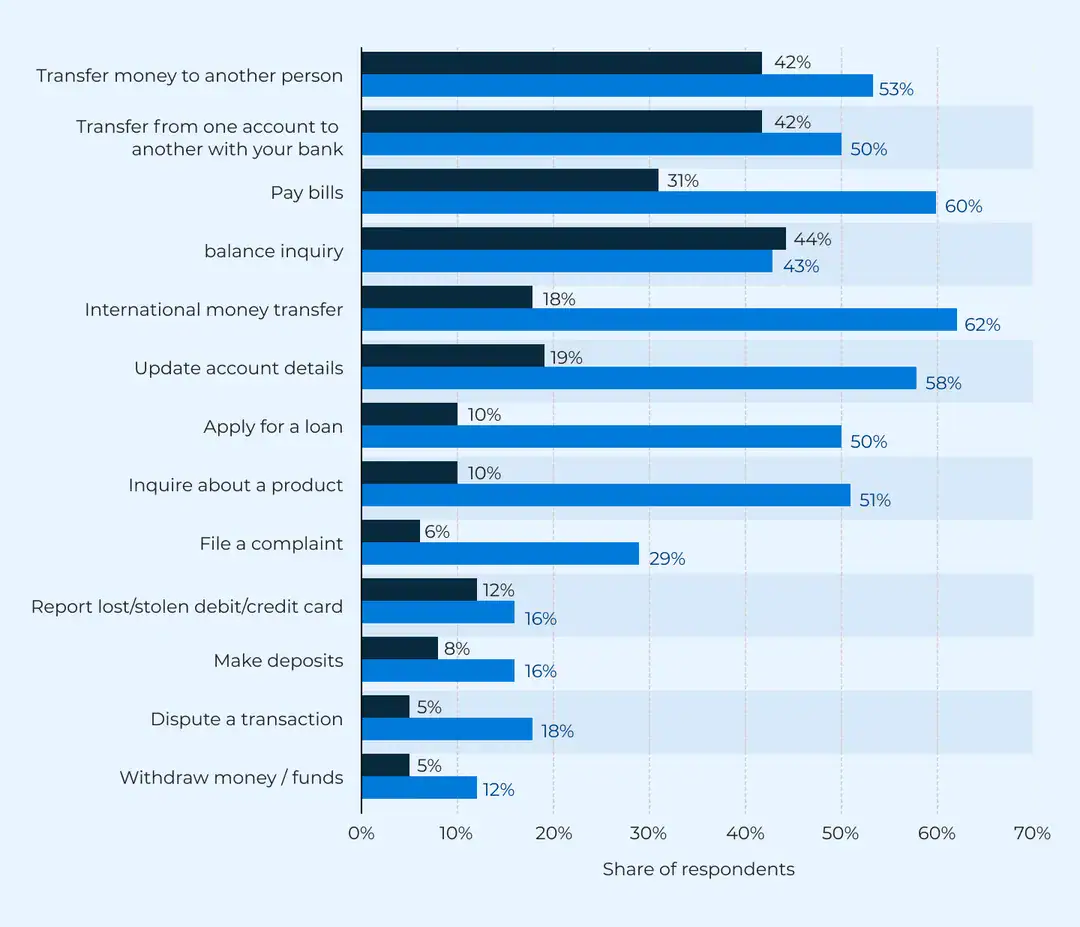
Why Banks Need a Digital-First Approach?
- 53% of users transfer money to another person digitally.
- 50% transfer funds between their own accounts using digital platforms.
- 60% pay bills through online or mobile banking services.
- 44% check their account balance using digital channels.
- 62% use digital services for international money transfers.
- 58% update their account details online.
- 50% apply for loans through digital platforms.
- 51% inquire about banking products digitally.
- 29% file complaints using online platforms.
- 16% report lost or stolen debit or credit cards through digital channels.
- 16% make deposits digitally.
- 18% of dispute transactions are handled online.
- 12% withdraw funds using digital tools.
(Reference: DigiPay.Guru, Coinlaw.io)
Usage Statistics
- The United States, Canada, Japan, China, and Europe are expected to drive a 13% CAGR in the global investment banking sector.
- China is projected to reach USD 4.6 billion by 2026 with a 19.9% CAGR, making it one of the fastest-growing digital banking markets.
- The Asia Pacific region, including India, Australia, and South Korea, is forecasted to achieve USD 615.6 million by 2026.
- Japan and Canada are expected to grow at 11% and 13.1% respectively from 2021 to 2026.
- Germany is projected to expand at approximately 14.5% CAGR, while the rest of Europe is anticipated to reach USD 5.2 billion by 2026.
- India has approximately 295.5 million digital banking users, exceeding the U.S. by more than 70 million users.
- Digital banking channels are estimated to account for over 90% of all banking interactions globally by 2025.
- Bank of America reports over 30 million active mobile app users and more than 40 million online banking customers.
- Net interest income from digital banks is expected to grow at 6.86% CAGR from 2024 to 2029, reaching USD 2.09 trillion by 2029.
- Customer deposits at digital banks are expected to exceed USD 5.4 trillion by 2029.
- Average digital spending per USD 1 billion in assets increased from USD 200,000 in 2022 to nearly USD 780,000 in 2024, reflecting a 310% rise.
(Source: G2.com, Inc., Statista)
Online Banking statistics
- The global number of online banking users reached 3.6 billion in 2025, reflecting widespread adoption of digital financial services.
- A consumer survey reported that 91% of users prioritize mobile and online banking access, including P2P payments, budgeting tools, and investment features.
- Around 77% of all banking interactions now take place through digital channels, confirming the shift toward mobile and web platforms.
- In the United Kingdom, 87% of adults use online or remote banking, representing nearly 47 million individuals.
- Among millennials, 58% perform financial tasks on mobile apps daily, and 85% engage in these activities at least once a week.
- 77% of Canadians, 71% of U.S. residents, and 69% of Spanish consumers use online banking services at least once per month.
- 79% of internet users who do not trust AI are less likely to use online banking, compared to 88% of users who trust AI, showing a strong link between trust in technology and digital banking adoption.
- Online chat services that connect customers to human representatives report a 66% satisfaction rate, indicating high acceptance of assisted digital support.
- 54% of financial service providers consider chatbots a key tool for improving the customer experience and strengthening digital engagement.
AI in Banking Statistics
- A 61% growth in AI adoption across financial institutions is projected by 2025.
- AI can increase productivity in the banking sector by 5% and reduce global expenditures by up to $300 billion.
- 79% of customers believe digital innovations make banking more accessible and convenient.
- AI adoption in banking is expected to grow by 52% by 2025.
- AI can automate 20% of banking and financial processes, improving operational efficiency.
- Banks using AI have reported a 34% increase in revenue.
- By 2025, AI could generate up to $140 billion in revenue for the global banking industry.
- By 2030, AI has the potential to reduce operational costs for banks by 22%.
- AI-based fraud detection in banking is projected to reach a market size of $68.6 million by 2026.
- 17% of decision-makers focus on AI for investment personalization, 15% for credit scoring, and 13% for portfolio optimization.
- By 2025, 85% of customer interactions in banking are expected to be supported by AI technologies.
- 83% of banking executives believe AI and digital banking increase the risk of cyber threats.
(Source: market.biz)
Key Trends in Digital Banking
- AI is becoming central to digital banking for fraud detection, personalized services, and automating back-office operations.
- Global spending on generative AI in banking is projected to reach $9.33 billion in 2025.
- Digital wallets are expected to account for 49% of all sales by 2027, reflecting strong consumer adoption.
- Embedded finance is viewed as core or complementary to strategy by 70% of banking executives, supporting expansion into new digital ecosystems.
- Security remains a priority as digital transactions increase, with $11.4 billion invested in fraud-prevention technologies in 2025.
- 64.2% of mobile banking app users rely on biometric authentication for enhanced security.
- Banks are prioritizing hyper-personalization, omnichannel consistency, and seamless digital interactions.
- Despite progress, many institutions still face challenges due to fragmented legacy systems that limit user experience quality.
You May Like This
- Open Banking vs Open Finance
- Embedded Lending vs Embedded Finance
- Digital Assets vs Cryptocurrency: Key Insights
- A New Financial Era: Comparing DeFi and Traditional Finance
Digital Banking Platform Market Size
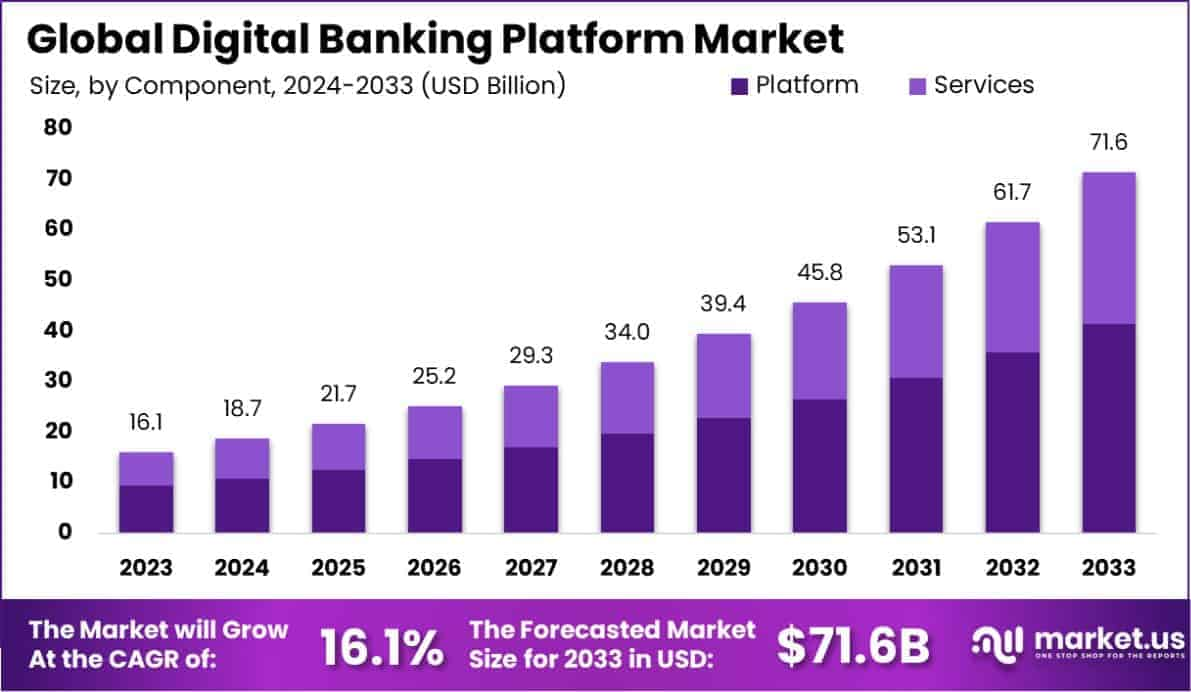
- According to Market.us, The Global Digital Banking Platform Market is projected to reach USD 71.6 Billion by 2033, rising from USD 16.1 Billion in 2023 at a 16.1% CAGR from 2024 to 2033.
- The Platform segment led the market in 2023 with a 58% share in the By Component category, reflecting strong demand for scalable and integrated banking platforms.
- On premise deployments held a dominant 70.3% share in 2023, supported by institutions prioritizing control, security, and regulatory compliance.
- Online Banking accounted for more than 78% share in 2023, remaining the preferred mode due to rising digital usage and customer expectations for remote services.
- Investment banking led the By Type segment with a 35% share, driven by the need for advanced digital tools in trading, advisory, and wealth management services.
- Asia Pacific dominated the global market with a 33% share in 2023 and recorded USD 5.32 Billion in revenue, supported by rapid digital adoption and strong fintech expansion.
(Image source: Market.us)
Digital Banking Platform & Services Market Size
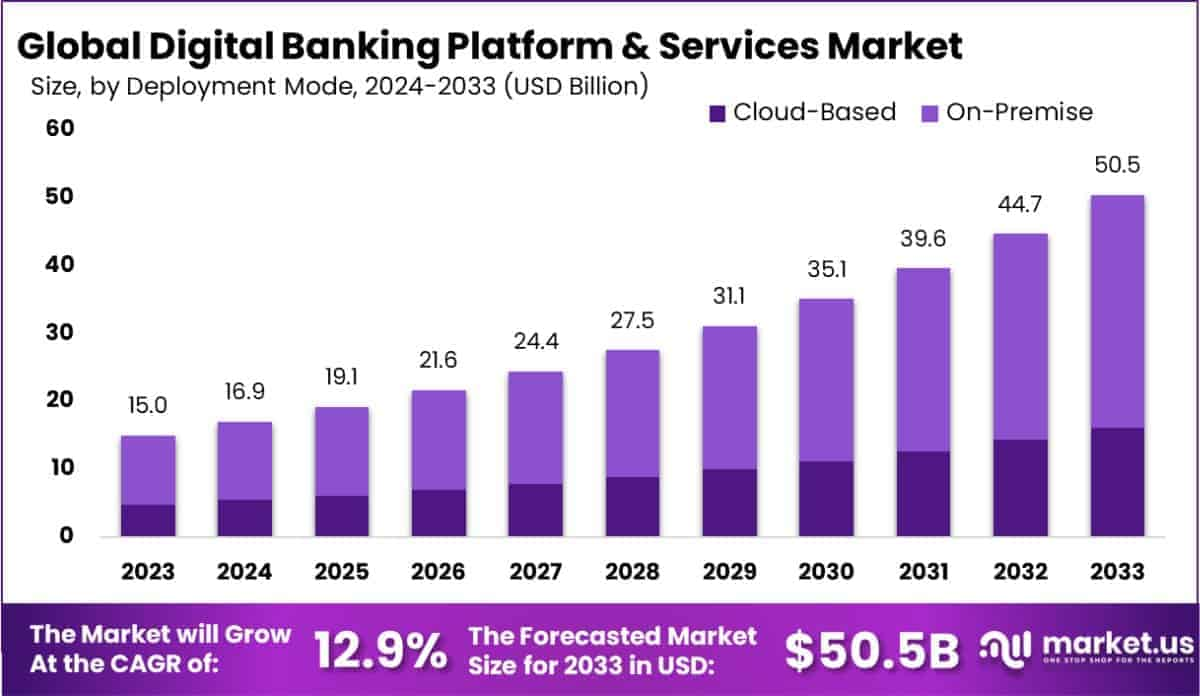
- The Global Digital Banking Platform and Services Market is projected to reach USD 50.5 Billion by 2033, rising from USD 15.0 Billion in 2023 at a 12.9% CAGR during 2024 to 2033.
- The Platform segment led the Component category in 2023 with a 62.5% share, reflecting strong demand for modular and scalable digital banking solutions.
- On premise deployments dominated in 2023 with a 68.1% share, supported by financial institutions prioritizing security, data control, and compliance.
- Online Banking held a leading 77.3% share in the Banking Mode segment in 2023, driven by widespread digital channel usage among retail and enterprise customers.
- Retail Banking accounted for more than 47.0% share in the Banking Type segment in 2023, supported by high consumer adoption of digital services and growing mobile banking usage.
- Asia Pacific led the global market with a 36.5% share in 2023 and recorded USD 5.47 Billion in revenue, reflecting rapid digitization and strong fintech investments across the region.
(Image source: Market.us)
Generative AI Spending in Banking
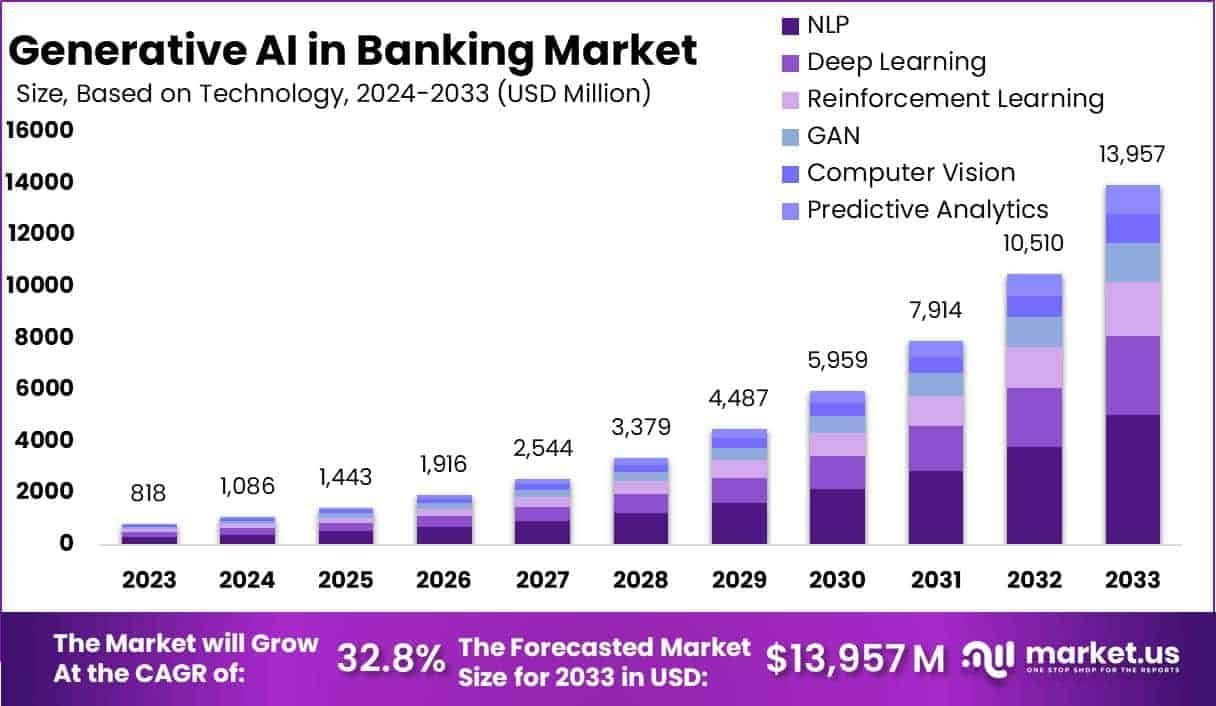
- In 2025, the market size reached USD 1,443 million, supported by rising demand for automation, risk analysis, and customer-facing AI tools.
- In 2026, the market expanded further to USD 1,916 million, driven by the growing application of advanced models such as deep learning and reinforcement learning.
- In 2027, the market rose to USD 2,544 million, as banks continued to invest heavily in AI for fraud detection, compliance, and personalization.
- In 2028, the value climbed to USD 3,379 million, showing accelerated growth as generative AI matured and broader use cases emerged.
- In 2029, the market reached USD 4,487 million, supported by large-scale deployment of AI-powered decision systems across major banks.
- In 2030, the market size increased to USD 5,959 million, demonstrating stronger adoption of GANs, predictive analytics, and computer vision in banking workflows.
- In 2031, the market grew significantly to USD 7,914 million, driven by rapid digital transformation and AI-enabled customer service automation.
- In 2032, the market value reached USD 10,510 million, indicating widespread integration of generative AI across back-office and front-office banking operations.
- In 2033, the Generative AI in Banking Market is projected to reach USD 13,957 million, supported by continuous innovation and the scaling of AI applications across global financial institutions.
(Image source: Market.us)
Digital banking security statistics
- Merchant losses from online payment fraud worldwide are projected to exceed $362 billion between 2023 and 2028.
- Losses are expected to reach $91 billion in 2028 alone.
- About 57% of Americans trust financial institutions to protect their personal data.
- Around 30% of customers without online bank accounts cite security concerns as their main barrier.
- Individuals reported nearly $8.8 billion in financial fraud losses in 2022, a 30% increase compared to 2021.
- In 2022, 62% of new accounts created by criminals were financial accounts, making new accounts 9.5 times riskier than mature ones.
- About 67% of Account Takeover victims reported that criminals used their exposed data to make unauthorized purchases.
- 87% of consumers say convenience is more important than security when using financial services.
- In 2023, U.S. mobile banking users viewed the ability to detect breaches involving their Social Security number as the most valuable feature.
Regional Insights
- North America: Digital banking usage remains strong, with 78.2% of U.S. adults using digital financial services in 2025. Growth is supported by advanced mobile platforms, real time payments, and partnerships between banks and fintech firms.
- Europe: Digital adoption increased by 13.6%, and the UK reached 80.5% adult usage in 2025. Expansion is driven by PSD2 compliant innovations, open banking APIs, and financial tools aligned with ESG priorities.
- Asia Pacific: The region accounts for 52.3% of global digital banking growth in 2025. India and China lead due to UPI expansion, super app ecosystems, and rapid adoption of embedded finance models.
- Latin America: Usage continues to rise, with 48.9% of Brazilians relying on digital banks as their primary financial service. Growth is supported by mobile first platforms, increased fintech investment, and cashless economy initiatives.
- Africa: Adoption is rising quickly. Kenya, Nigeria, and South Africa represent 26.4% of digital banking users across the continent in 2025. Mobile wallets, neobanks, and financial inclusion programs support this momentum.
- Middle East: Digital banking adoption grew by 28.1% in 2025. The UAE and Saudi Arabia lead the region, supported by national digital transformation agendas, Sharia compliant fintech offerings, and simplified onboarding processes.
- Australia: Adoption remains among the highest globally. About 86.7% of the population used digital banking in 2025, supported by strong neobank competition, strict cybersecurity standards, and widespread use of contactless payments.
Key Benefits
- You can bank anytime, day or night, from your phone or computer, no need to rush to a branch.
- It saves money with lower fees since banks don’t need as many buildings or staff.
- Transactions happen super fast, like instant transfers or bill pays, without waiting in lines.
- Strong security like fingerprints or face scans keeps your money safer from thieves.
- Helps the planet by cutting down on paper statements and less travel to banks.
- Gives personal tips on spending and saving right in the app, like a helpful friend.
Opportunities
- AI can make banking feel personal, suggesting deals just for you based on your habits.
- More people worldwide joining means banks can grow fast in new places.
- Blockchain makes sending money across borders quick and cheap, no middlemen.
- Automation handles boring tasks, freeing people for better customer chats.
- Opens doors for small businesses with easy loans and tools to track cash flow.
- Teams up with apps for shopping or investing, making one-stop finance easy.
Challenges
- Hackers target apps, so one big breach could lose people’s trust and money.
- Not everyone has internet or smartphones, leaving some folks behind.
- Tech glitches or app crashes frustrate users when they need money quick.
- Older people might find apps confusing without face-to-face help.
- Banks spend big on new tech, hard to keep up without losing old customers.
- Rules keep changing, making it tough to stay safe and legal everywhere.
Conclusion
Digital banking is transforming how people use financial services every day. More and more users are switching to mobile apps, making banking easier and accessible anytime. In the coming years, technologies like AI, automation, and blockchain will help banks offer more personalized services, stronger security, and greater convenience. As digital banking grows worldwide, it will continue leading innovation and providing user-friendly banking experiences that keep up with changing customer needs.
Sources:
- https://livebank24.com/digital-banking/key-digital-banking-statistics-trends-and-insights-in-2025/
- https://learn.g2.com/digital-banking-statisticshttps://www.absrbd.com/post/digital-banking-statistics
- https://www.self.inc/info/digital-banking-statistics/
- https://www.bankrate.com/banking/digital-banking-trends-and-statistics/#digital
- https://coinlaw.io/digital-banking-statistics/
- https://wallethub.com/edu/online-banking-statistics/142729
- https://market.biz/digital-banking-statistics/
- https://market.us/report/digital-banking-platform-market/