

Introduction
Voice AI Agents Statistics: Voice AI agents are software systems designed to understand spoken language and respond through natural voice interactions. These systems combine speech recognition, language understanding, and speech synthesis to communicate with users in real time. They are widely used in customer support, virtual assistants, and automated service environments. The technology focuses on enabling smooth, human-like conversations without manual input.
The use of voice AI in customer operations has resulted in consistent reductions in overall operating costs. Many organizations report cost savings of around 20-30%, mainly due to automation of repetitive call tasks such as inquiries, confirmations, and basic troubleshooting. These efficiencies reduce dependence on large support teams and lower ongoing training and staffing expenses. Operational spending becomes more controlled as automated systems handle increasing call volumes.
In advanced implementations, cost reductions are reported to be substantially higher when compared with traditional in-house call centers. Voice AI platforms can manage a large share of interactions without human intervention, lowering infrastructure and supervision costs. Continuous availability also reduces the need for overtime or shift-based staffing models. Over time, this leads to more stable and predictable cost structures.
Key Statistics
- A leading telecom provider achieved a 35% reduction in call handling time after integrating Voice AI.
- Customer satisfaction increased by 30% on average post Voice AI adoption in service operations.
- Some solutions cut queue times by up to 50%, improving overall service efficiency.
- 50% of consumers have already interacted with voice assistants for service-related inquiries.
- By 2026, nearly 80% of enterprises are expected to use AI-driven voice technology in customer service.
- Businesses deploying voice-based AI tools report 20-30% lower operational costs due to automation.
- 71% of consumers use voice assistants to research products before making purchases.
- 89% of customers are more inclined toward brands offering Voice AI-enabled support.
- In the U.S., 62% of adults use voice assistants regularly, while around 100 million Americans own at least one smart speaker.
- In markets such as the UK and India, approximately 20% of households have a voice-enabled speaker.
- Globally, about 20.5% of internet users conduct voice-based searches.
- In the U.S. specifically, 58.6% of people have tried voice commands or voice search at least once.
Voice AI Agents Market Overview
The Voice AI Agents market refers to the ecosystem of artificial intelligence systems that interact with users using natural voice commands and responses. These agents include voice-enabled assistants, conversational bots, and automated call handlers powered by technologies such as speech recognition, natural language processing, and real-time dialogue management.
Voice AI agents are applied in customer support, call centers, healthcare, retail, and enterprise environments to automate interactions and deliver human-like responses. Their adoption is supported by increasing digitalisation across industries and the need for efficient, scalable user engagement solutions.
Voice AI agents work by processing spoken language, interpreting user intent, and generating conversational replies that can fulfil requests or guide users through tasks. These systems rely on advanced algorithms and large language models to understand context, eliminate ambiguity, and maintain fluid interactions with users.
As enterprise spending grows, voice AI platforms are being integrated with backend systems to support complex workflows such as transaction processing, information retrieval, and multilingual communication. The market has witnessed rapid expansion and is expected to attract substantial investment as organisations pursue automated, voice-centric engagement strategies.
Voice AI Agents Market Size
- The global Voice AI agents market is set for rapid expansion, projected to reach USD 47.5 billion by 2034, up from USD 2.4 billion in 2024, reflecting a strong 34.8% CAGR from 2025 to 2034.
- North America led adoption in 2024 with over 40.2% share, supported by early enterprise uptake and mature AI ecosystems. The U.S. market alone reached USD 1.2 billion, underlining strong demand for voice-enabled automation.
- Voice AI platforms dominated with 76.4%, showing preference for integrated solutions that combine speech recognition, analytics, and orchestration capabilities.
- On-premises deployment accounted for 62.6%, driven by enterprise requirements for data security, regulatory compliance, and customization.
- Large enterprises represented 70.5% of adoption, reflecting investments aimed at improving operational efficiency and customer engagement at scale.
- The BFSI sector led with 32.9%, highlighting strong use of voice AI for customer service automation, authentication, and transaction support.
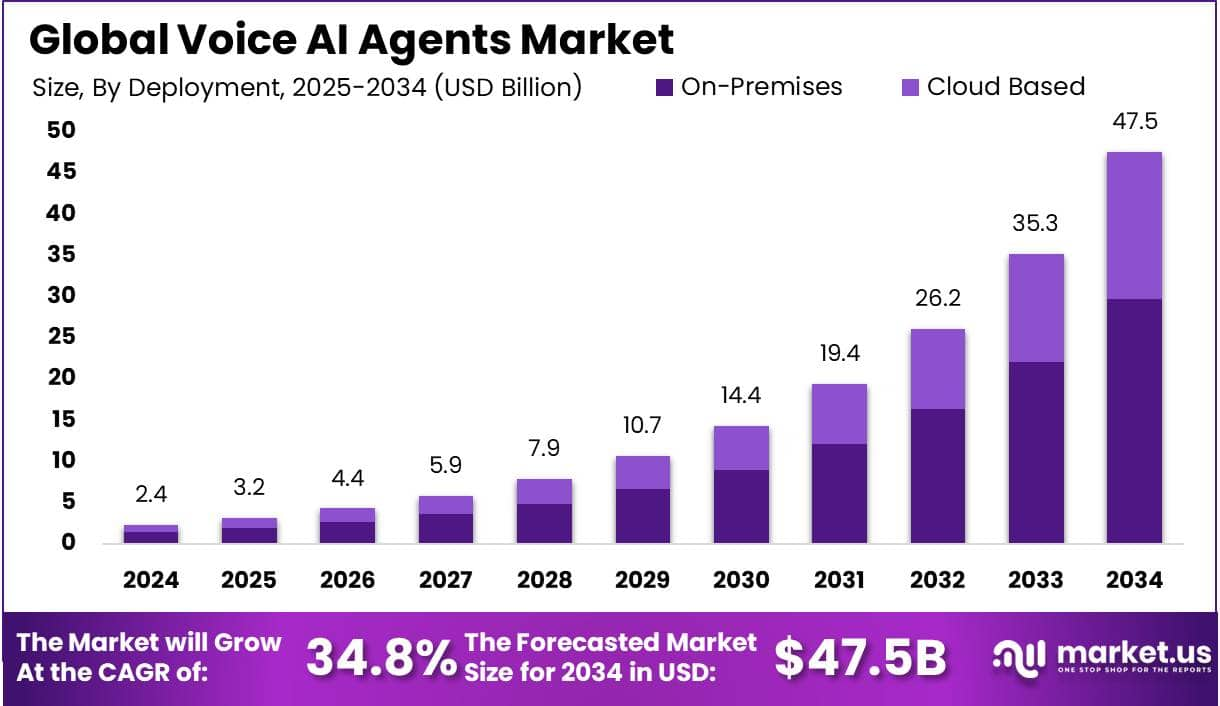
(credit: market.us)
Performance Gains
Voice AI has shown clear improvements in call handling efficiency across multiple use cases. Average handling time is reduced by nearly 35%, as AI systems quickly understand intent and deliver accurate responses. This allows human agents to focus on complex cases that require judgment or empathy. Overall productivity improves as workflows become more streamlined.
Queue times are also significantly shortened, with reductions of up to 50% reported in high-volume environments. Faster response times improve customer experience and reduce frustration during peak hours. First Call Resolution rates for AI-driven interactions now typically fall between 70% and 85%. These outcomes reflect stronger intent recognition and more consistent service delivery.
Emerging Trend Analysis
A significant emerging trend in the Voice AI Agents market is the emphasis on emotional and contextual intelligence in voice interactions. Developers are integrating models that can recognise tone, sentiment, and user context, enabling agents to respond more empathetically and adaptively in real-time conversations. This trend expands the utility of voice agents beyond rigid scripted responses toward more intuitive and personalised user engagements across service and support functions. The evolution aligns with broader expectations that automated systems should replicate more natural human interaction patterns.
In parallel with emotional intelligence, multilingual voice agent capabilities are advancing to support global and linguistically diverse user bases. Voice AI solutions are increasingly configured to understand and respond in multiple languages seamlessly, reducing barriers to adoption in international markets and diverse regional contexts. This multicultural support is driving adoption in sectors such as banking, travel, and public services, where language flexibility improves accessibility and user satisfaction. The integration of multilingual capabilities points to broader deployment of voice AI agents across both consumer and enterprise domains.
Driver Analysis
The primary driver of the Voice AI Agents market is the growing demand for automated and efficient customer engagement solutions. Organisations are increasingly investing in voice AI to manage high volumes of customer interactions with reduced latency and staffing costs, particularly in contact center operations. These agents can handle routine queries, freeing human agents to focus on complex tasks. As digital transformation initiatives accelerate, voice AI agents become essential tools for sustaining seamless and responsive service delivery.
Another driver is the continuous advancement in underlying technologies such as automatic speech recognition, natural language processing, and real-time text-to-speech synthesis. Improvements in these domains enhance the accuracy, responsiveness, and reliability of voice AI agents, making them more appealing for enterprise integration. As voice AI systems become more capable, businesses are more willing to adopt them for diverse applications beyond basic customer support, including sales assistance and internal knowledge access.
AI Agent Statistics and Adoption Trends
- Adoption is accelerating rapidly, with 78% of organizations already using AI in some capacity and 85% deploying AI agents in at least one operational workflow.
- The agent technology stack is increasingly modular, combining large language models, agent frameworks, orchestration layers, developer platforms, and governance controls.
- Usage spans multiple business functions, including software development, content creation, scheduling, analytics, and customer support, delivering measurable productivity gains.
- Human oversight remains critical, as most enterprises favor human-in-the-loop models, particularly for high-impact or high-risk decisions.
- Market momentum is strong, expanding from USD 3.7 billion in 2023 to USD 7.38 billion in 2025, with projections exceeding USD 100 billion by 2032.
- Agent autonomy is advancing, with systems evolving from simple task execution toward goal-oriented behavior supported by memory, reasoning, and retry mechanisms.
- The long-term direction favors stackable and composable architectures, where organizations design custom workflows using AI agents as foundational building blocks.
Enterprise Adoption Trends
- 90% of companies using Generative AI agents report smoother operations and improved workflows, accelerating task automation across functions.
- 51% of organizations are exploring AI agent integration, with 35–37% piloting deployments for use cases like code generation and customer service.
- Full GenAI adopters lead, with 82% planning agent rollouts for efficiency gains.
Productivity Impact
- Businesses with AI agents experience a 61% boost in employee efficiency, freeing workers for creative and strategic roles by handling data analysis and routine processes.
- Related gains include 126% faster developer tasks, 20-80% workflow reductions, and up to 128% ROI in customer experience.
- Top firms anticipate 171% average ROI, emphasizing scalability in manufacturing, legal, and telecom.
Consumer Sentiment
- 39% of consumers feel comfortable using AI agents, especially for scheduling (39%) or personalized content (37%).
- Gen Z shows stronger affinity, with 32% open to agent-driven shopping and 44% favoring personal assistants over humans.
- Preferences lean toward speed: 54% prioritize quick resolutions, 34% avoid repetition via agents, and 36% opt for automated purchases.
Key Vertical Statistics
Healthcare
The healthcare sector is showing strong momentum in the adoption of AI agents for operational and administrative tasks. Around 90% of hospitals are projected to use AI agents by 2025–2026, primarily to manage patient documentation, appointment scheduling, and routine inquiries. This shift is driven by the need to reduce administrative workload and improve workflow efficiency. AI agents help standardize processes and ensure timely handling of high volumes of patient interactions.
Voice AI solutions also support improved accuracy and consistency in healthcare records. Automated documentation reduces manual errors and supports better compliance with internal procedures. Scheduling automation helps lower no-show rates and improves patient access to care. Over time, these improvements contribute to better resource utilization and enhanced patient experience.
Organizational Impact
- 70% of healthcare organizations report that Voice AI has improved patient care, through faster triage, reduced administrative tasks (up to 70%), and better adherence.
- Deployments yield 28-47% gains in outcomes like lower readmissions, fewer missed appointments (40–60%), and enhanced satisfaction.
- Hospitals and clinics prioritize it for documentation, discharge follow-ups, and chronic disease management, with nearly half of U.S. facilities planning adoption by 2026.
Consumer Perspectives
- 39% of consumers believe AI will improve healthcare over the next five years, reflecting optimism amid growing familiarity with voice interfaces.
- Surveys show 31-54% already use generative AI for health queries between visits, valuing reassurance, empowerment, and reduced anxiety.
- Trust lags at 38% for healthcare AI, but informed patients report better physician interactions and proactive self-management.
Retail
Retail remains one of the fastest-moving sectors in AI agent adoption. About 63% of retailers already use AI agents across marketing, inventory management, and customer service functions. These tools help retailers manage large customer bases while maintaining consistent communication. AI-driven insights also support more responsive pricing, promotions, and demand planning.
In inventory and customer service operations, AI agents improve speed and accuracy. Automated stock monitoring reduces overstock and out-of-stock situations. Voice and chat AI shorten response times and support personalized interactions at scale. Together, these applications strengthen operational efficiency and customer satisfaction.
Automotive
The automotive sector is actively experimenting with voice AI technologies. Nearly 75% of automotive companies are currently piloting at least one voice AI use case, often focused on customer support, sales assistance, or connected vehicle features. These pilots reflect a broader shift toward digital-first engagement models. Early adoption is helping companies test efficiency gains before full-scale deployment.
Voice AI is also being applied across aftersales and dealership operations. Automated systems manage service bookings, maintenance reminders, and customer follow-ups more efficiently. This reduces pressure on service staff and improves consistency across touchpoints. As pilot programs mature, wider adoption across the automotive value chain is expected.
Voice AI in Customer Service
- A large telecom operator achieved a 35% reduction in average call handling time after deploying voice AI solutions.
- A study by IBM reported a 30% increase in customer satisfaction following voice AI implementation in service operations.
- Advanced voice AI systems can cut customer queue times by up to 50%, improving response speed and service availability.
- About 50% of consumers have already used voice assistants for customer support interactions.
- Nearly 80% of businesses plan to adopt AI-driven voice technologies in customer service by 2026.
- Organizations using AI-powered service tools report 20–30% reductions in operational costs through automation.
- Around 71% of consumers use voice assistants to browse and research products before purchasing.
- Customer preference is strong, with 89% indicating higher likelihood of choosing brands that offer voice AI support.
Voice AI and Shopping Behavior
- About 50% of consumers have completed at least one purchase using a voice assistant.
- Roughly 25% are considering making voice-based purchases in the future, signaling growing intent.
- Satisfaction levels are high, with 80% of voice shoppers reporting a positive experience.
- Product discovery remains a key use case, as 71% rely on voice assistants for pre-purchase research.
- Advocacy is emerging, with 39% of voice shoppers recommending the experience to others.
- Upsell impact is notable, as 24% of voice shoppers report spending more than initially planned.
(source: verloop.io)
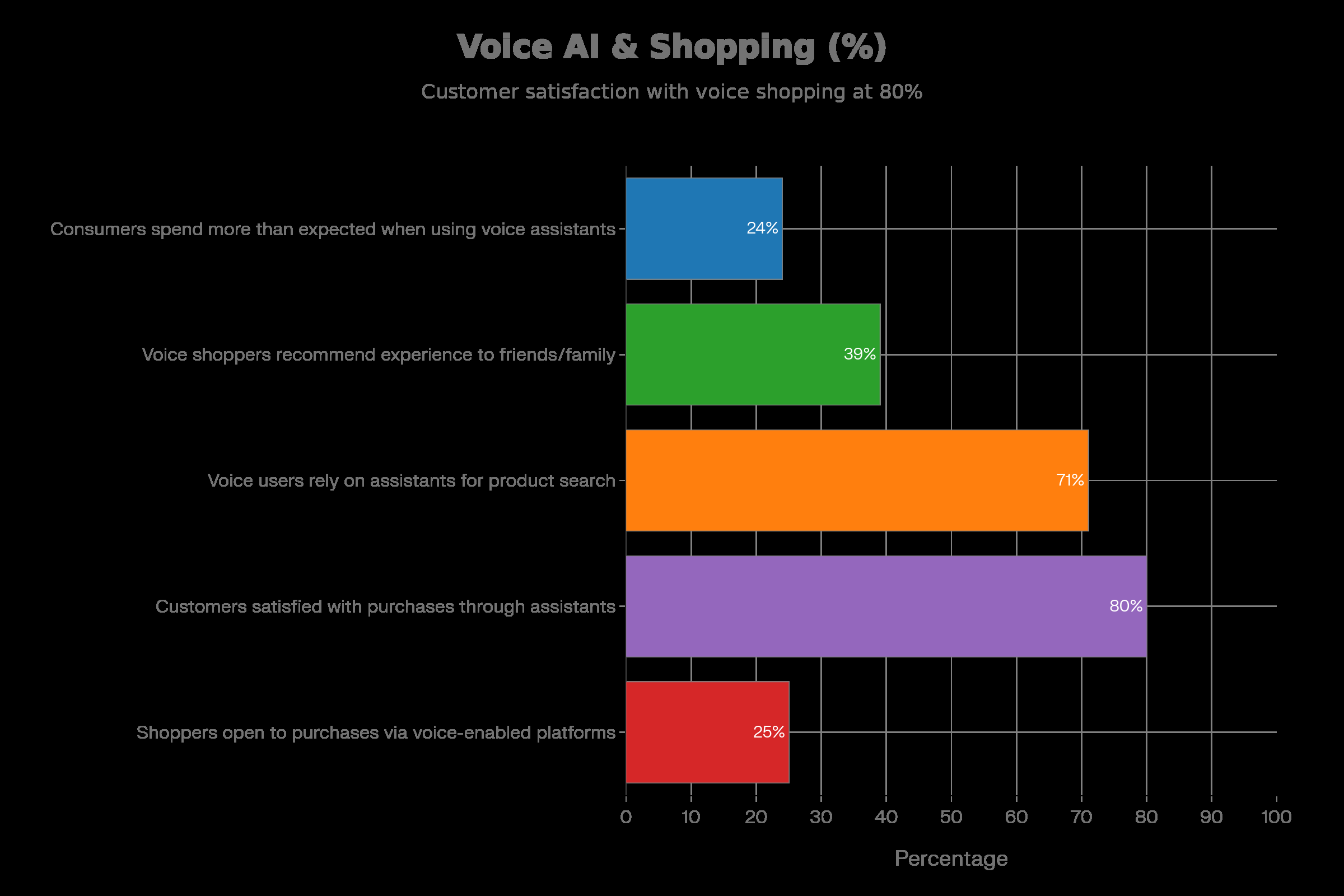
| Shopping Behavior Indicator | Share (%) |
|---|---|
| Consumers spending more than expected when using voice assistants | 24% |
| Voice shoppers recommending the experience to friends or family | 39% |
| Users relying on voice assistants for product research | 71% |
| Customers satisfied with purchases through voice assistants | 80% |
| Shoppers open to future purchases via voice enabled platforms | 25% |
(source: market.biz)
Conclusion
The Voice AI Agents market is positioned as a foundational layer in modern digital interaction strategies across industries. Growing demand for faster, scalable, and always-available voice based engagement continues to support adoption, especially in customer service, enterprise operations, healthcare, and financial services. Advancements in speech recognition, language understanding, and voice synthesis are steadily improving reliability and usability, making voice agents more practical for real-world deployment.
Explore More
- Top Drone Companies Shaping Global Market Growth
- Statistical Analysis of the Insurance Industry
- Open Banking vs Open Finance
- Embedded Lending vs Embedded Finance
- Digital Assets vs Cryptocurrency: Key Insights
- A New Financial Era: Comparing DeFi and Traditional Finance
Sources:
- https://elevenlabs.io/blog/voice-agents-and-conversational-ai-new-developer-trends-2025
- https://economictimes.indiatimes.com/news/company/corporate-trends/voice-ai-moves-beyond-scripts-as-indian-firms-tap-multilingual-bots/articleshow/123670740.cms
- https://voiceaiwrapper.com/insights/voice-ai-market-analysis-trends-growth-opportunities
- https://www.index.dev/blog/ai-agents-statistics
- https://www.verloop.io/blog/voice-ai-statistics/
- https://market.us/report/voice-ai-agents-market/
- https://market.biz/voice-ai-agents-statistics/