

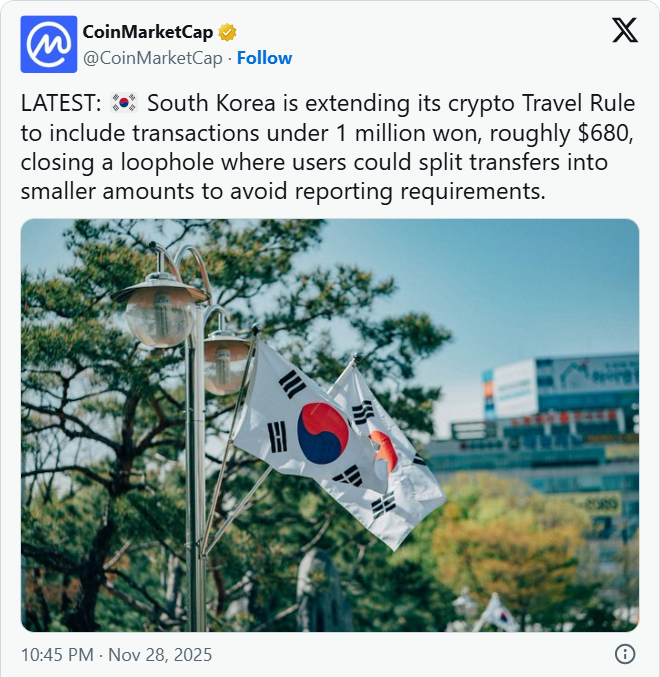
South Korea has rolled out a tough new anti-money laundering (AML) crackdown targeting the cryptocurrency sector, marking a major shift in how digital assets are regulated in the country. The government is closing loopholes that allowed small crypto transfers to slip under the radar, expanding the “Travel Rule” to cover all transactions – even those below 1 million won (about $680). This move aims to prevent criminals from splitting large transfers into smaller, untraceable amounts.
Key Highlights: TLDR
- South Korea’s Financial Services Commission (FSC) expands the crypto travel rule to all transactions, including those under 1 million won ($680), requiring sender/recipient details and real-name verification for every transfer to block evasion tactics.
- High-risk offshore exchanges will face bans from operating in South Korea, with all platforms undergoing stricter financial, reserve, and compliance checks.
- Individuals with serious criminal records, like drug offenses or tax evasion, barred from major shareholder roles in licensed virtual asset service providers (VASPs).
- Financial Intelligence Unit (FIU) introduces preemptive account freezes for suspected illicit funds, targeting crimes such as narcotics and illegal gambling.
- FSC to finalize rules in first half of 2026 and submit amendments to the Specific Financial Information Act to the National Assembly, aligning with FATF standards.
Travel rule now applies to every transfer
The Financial Services Commission’s updated regime will extend the crypto “travel rule” to all virtual asset transactions, including transfers below 1 million won, closing the previous gap that allowed users to evade checks by splitting large payments into smaller ones.
Crypto exchanges will have to collect and share sender and recipient information and apply real-name and identity verification checks on every transfer, aligning Korea more closely with Financial Action Task Force guidance.
Impact on Crypto Market
These measures are pushing up compliance costs, especially for smaller exchanges. Analysts expect market consolidation as smaller platforms struggle to keep up, while larger ones invest heavily in compliance teams and systems.
The stricter rules also mean more transparency for investors, as platforms must report suspicious activities and keep detailed records. South Korea is now seen as a global leader in crypto regulation, aligning with international standards set by the FATF and other watchdogs
Hard line on high‑risk offshore exchanges
Regulators plan to block foreign crypto platforms that are not licensed in South Korea and are considered high risk for money laundering or fraud. All exchanges operating in the country will face tougher financial and compliance reviews, including tests of reserves, internal controls, and overall AML systems before and after licensing.
Screening out criminal ownership
Under the reform package, people with serious criminal records, including offenses such as drug trafficking or tax evasion, will be barred from becoming major shareholders in licensed virtual asset firms. Authorities want to prevent criminal groups from controlling exchanges or other virtual asset service providers behind the scenes, tightening governance standards across the sector.
Preemptive account freezes and professional support
The Korea Financial Intelligence Unit will introduce a preemptive account-freeze mechanism so investigators can quickly lock accounts suspected of holding criminal proceeds, especially in cases involving narcotics and illegal gambling.
The government also plans to bring in more lawyers, accountants, and tax experts to strengthen AML infrastructure, and to expand VASP registration reviews to cover financial soundness and “social credibility.”
What’s Next?
The crackdown is not just about penalties – it’s about building a secure, trustworthy crypto ecosystem. By enforcing these rules, South Korea aims to attract institutional investors and international capital. The government is also working on a delayed tax policy expected in 2027, which could further shape market dynamics. For now, all crypto businesses in South Korea know: strict AML is the new normal.
Internet News Times Final Take
South Korea’s new crypto rules make exchanges check every trade, even small ones under 700 dollars, to stop money laundering. Big fines hit companies like Upbit’s owner Dunamu for past slip-ups, and now regulators block risky foreign sites while barring criminals from owning local firms.
Small traders face extra steps to verify accounts, and some platforms may close due to high costs. Yet this clears out bad players and lets banks join safely in a market over 100 trillion won strong.
You May also like this
- AI Agents Statistics: Market Size, Adoption Rate and Trends
- Voice AI Agents Statistics, Market Size and Adoption Trends
- Streaming Services Statistics by Category and Emerging Trends
- Top Drone Companies Shaping Global Market Growth
- Statistical Analysis of the Insurance Industry