
AI Enabled Robot Picker Insights: AI enabled robot pickers are becoming a central technology in modern warehouses, especially in e commerce, retail, and third party logistics. They combine robotic arms or mobile robots with computer vision and machine learning to identify, grasp, and move items with high accuracy, even when product shapes, packaging, and locations vary. The goal is to raise throughput, cut labor dependency, and maintain consistent performance during peak seasons such as online sales events.
Performance metrics are equally striking. Case studies from logistics and e commerce operators show that AI enabled picking systems can increase picking productivity by roughly 40-80% compared with fully manual workflows, especially when used in goods to person layouts. Some large deployments report overall operating cost reductions of 30-50% after full automation, with payback periods often under 24 months, and in a few highly optimized projects, even under 12 months.
Key Performance Insights
- AI-powered robot pickers deliver over 99% picking accuracy, sharply reducing costly fulfillment errors.
- Advanced systems can handle up to 1,400 items per hour, supporting faster order turnaround.
- Order processing speeds improve by up to 40%, helping warehouses meet tight delivery timelines.
- Human and robot collaboration boosts overall productivity by as much as 85%, especially in high-volume operations.
- Labor costs typically decline by 30% to 50% after automation deployment.
- Many operators achieve return on investment in as little as two months, driven by efficiency gains and lower staffing pressure.
- Based on data from dhl, Productivity gains are clearly demonstrated, with per-hour picking output rising by 30% to 180%. This improvement is driven by robots handling travel and load movement, allowing human workers to focus on picking accuracy and value-added tasks.
- Workforce efficiency is further supported by an 80% reduction in training time, indicating that AMR-assisted workflows are intuitive and faster to onboard compared to traditional manual picking systems. This is particularly important in high-turnover logistics environments.
- At scale, over 3,000 AMRs are currently deployed by DHL worldwide, reflecting strong confidence among global logistics leaders in collaborative robotics. The fleet-level image underscores how these systems are designed for dense, parallel operations.
- Cumulatively, the LocusOne system has enabled more than 250 million units picked, confirming proven reliability and commercial maturity. From a market perspective, such performance benchmarks continue to accelerate adoption of AI-driven warehouse automation across retail, e-commerce, and third-party logistics networks.
Key Capability Insights
- Industrial-grade systems deliver over 99.5% picking accuracy, helping reduce fulfillment errors and improve delivery timelines.
- Peak performance reaches up to 1,400 picks per hour, allowing warehouses to scale order volumes without increasing headcount.
- High autonomy enables continuous, unsupervised operation, lowering cost per pick and accelerating order throughput.
- Strong versatility supports a wide range of item types, with configurable grippers, robots, and software to match different warehouse needs.
(data source: abb.com)
Market size and adoption
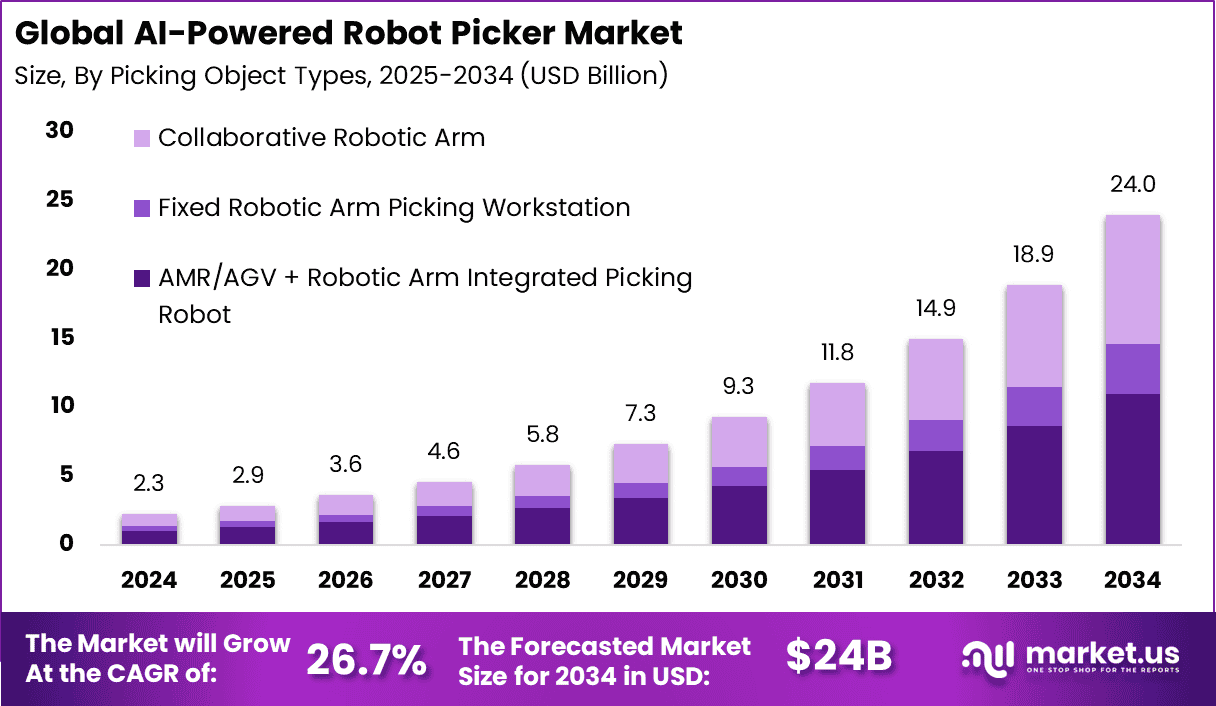
- The global AI-powered robot picker market generated USD 2.3 billion in 2024, showing strong momentum in warehouse automation.
- Market revenue is expected to rise from USD 2.9 billion in 2025 to nearly USD 24 billion by 2034, growing at a 26.7% CAGR.
- North America led the market in 2024 with over 37.6% share, generating around USD 0.8 billion in revenue.
- Mobile-type robot pickers dominated with 64.7%, as warehouses favor flexible robots that can move freely in changing layouts.
- AMR and AGV systems combined with robotic arms captured 45.8%, highlighting demand for robots that offer both mobility and precise picking.
- 3D vision recognition and posture estimation held 48.9%, showing the importance of advanced vision for accurate and damage-free handling.
- Retail and e-commerce accounted for 40.6%, driven by high order volumes and the need for faster fulfillment.
- North America maintained a 37.6% share due to early adoption of automation and large-scale logistics infrastructure.
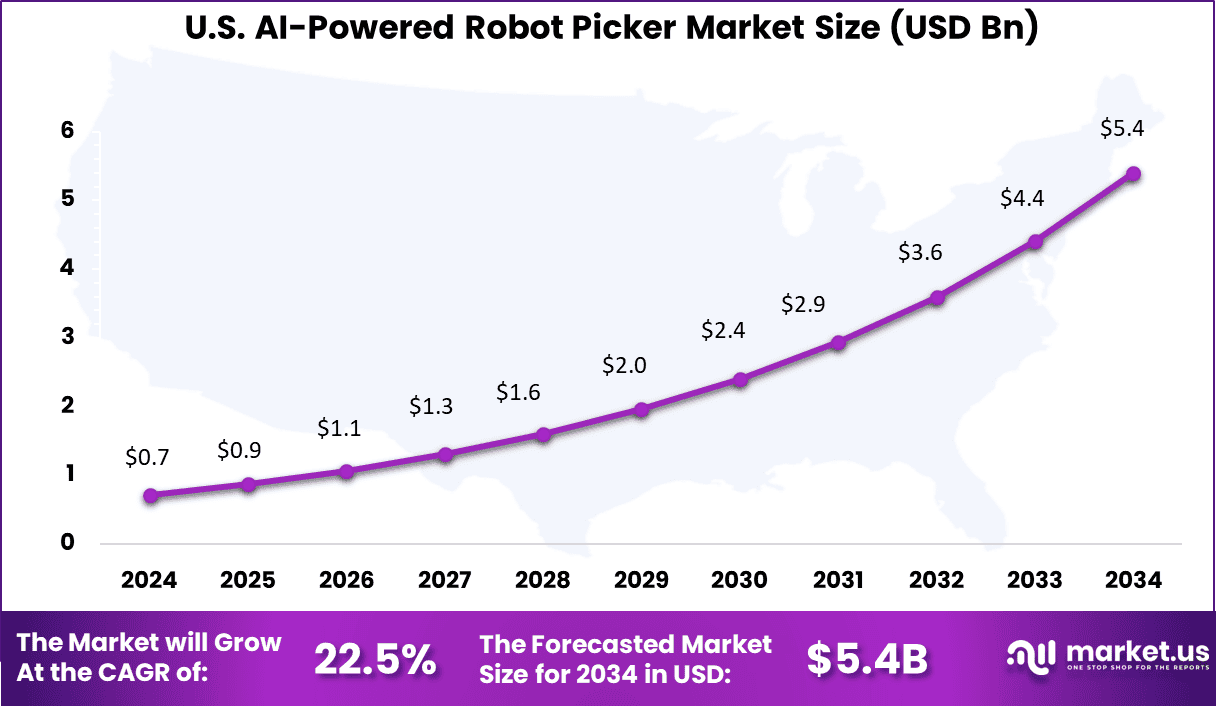
- The U.S. market reached USD 0.71 billion in 2024 and is growing at a 22.5% CAGR, supported by strong investment in AI-based fulfillment systems.
(source: market.us)
Labor shortages and rising wage costs are a structural driver of adoption. Surveys show that a large share of warehouse operators struggle to fully staff facilities, which pushes them toward automation that can run continuously. At the same time, e commerce customers expect next day or same day delivery, forcing operators to increase order volumes without sacrificing accuracy.
| Segment | Key Insight |
|---|---|
| Robot Type | Mobile-type robot pickers dominated with 64.7%, indicating strong demand for flexible and autonomous picking in dynamic warehouse environments. |
| System Configuration | AMR and AGV integrated with robotic arms accounted for 45.8%, reflecting rising preference for hybrid systems combining mobility with precise item handling. |
| Technology | 3D vision recognition and posture estimation held 48.9%, confirming advanced perception as a core requirement for accurate and damage-free picking. |
| End-Use Industry | Retail and e-commerce captured 40.6%, driven by high order volumes, fast fulfillment needs, and increased automation in distribution centers. |
| Region | North America recorded 37.6%, supported by early adoption of automation and large-scale warehouse infrastructure. |
| U.S. Market | The U.S. market reached USD 0.71 billion in 2024 with a 22.5% CAGR, reflecting rapid investment in AI-driven fulfillment automation. |
AI in Warehousing Market Size
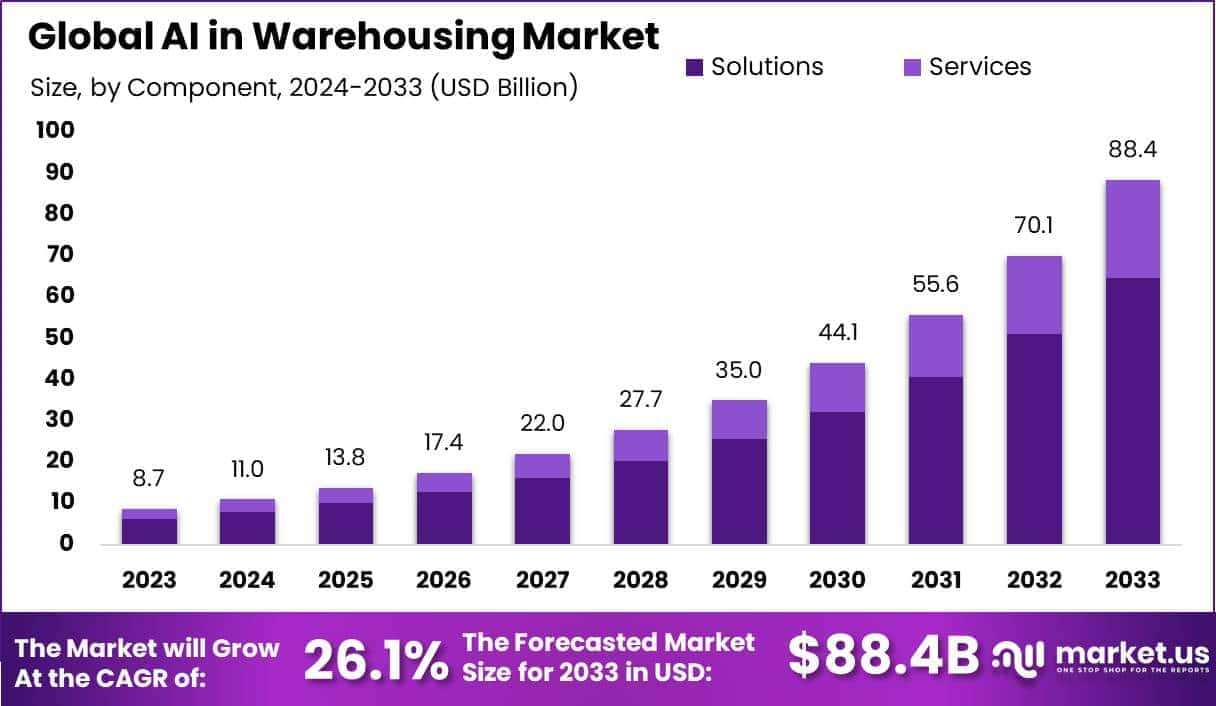
- The global AI in warehousing market is projected to reach USD 88.4 billion by 2033, rising sharply from USD 8.7 billion in 2023.
- The market is expanding at a strong 26.1% CAGR, driven by rapid digitalization of warehouse operations.
- In 2023, the solutions segment dominated with over 73% share, reflecting high demand for AI software platforms and analytics tools.
- Order picking and sorting led application adoption, capturing more than 30%, as warehouses focus on speed, accuracy, and labor efficiency.
- The e-commerce segment held over 37% share, supported by rising online orders and same-day delivery expectations.
- North America led the market with more than 38% share in 2023, generating about USD 3.3 billion in revenue.
- The global smart warehousing market is expected to reach USD 78.6 billion by 2033, growing from USD 20.3 billion in 2023 at a 14.5% CAGR.
- Warehouse automation is also gaining scale, with the market projected to hit USD 91.0 billion by 2033, up from USD 20.8 billion in 2023.
- A 15.9% CAGR in warehouse automation reflects sustained investment in robotics, conveyor systems, and AI-driven control platforms.
(source: market.us)
| Market | Key Insights |
|---|---|
| Solution Segment | In 2023, the solutions segment dominated the AI in warehousing market, accounting for more than 73% of the total market share, driven by high adoption of software platforms and AI-enabled systems. |
| Order Picking and Sorting | The order picking and sorting segment captured a leading share of over 30% in 2023, reflecting strong demand for automation to improve accuracy and fulfillment speed. |
| E-commerce End Use | The e-commerce segment led the market in 2023, holding more than 37% of the AI in warehousing market share due to high order volumes and rapid delivery expectations. |
| Regional Performance | North America dominated the AI in warehousing market in 2023 with over 38% market share, generating revenues of approximately USD 3.3 billion, supported by early automation adoption. |
| Smart Warehousing Market | The global smart warehousing market is expected to reach USD 78.6 billion by 2033, growing from USD 20.3 billion in 2023, at a CAGR of 14.5% during 2024 to 2033. |
| Warehouse Automation Market | The global warehouse automation market is forecast to expand to USD 91.0 billion by 2033, up from USD 20.8 billion in 2023, registering a CAGR of 15.9% over the forecast period. |
Regional Analysis
North America accounted for 37.6% of overall market share, driven by early adoption of automation technologies and the presence of large, highly organized warehouse networks. The region has seen consistent investments in robotics, AI software, and warehouse management systems, particularly across e-commerce, retail, and third-party logistics operations.
Strong digital infrastructure, high labor costs, and a continued focus on operational efficiency have supported faster integration of automated fulfillment solutions. As a result, North America remains a leading region for advanced warehouse automation deployment.

(source: market.us)
The U.S. market reached USD 0.71 billion in 2024 and is projected to grow at a strong 22.5% CAGR, reflecting rapid investment in AI-driven fulfillment automation. Growth has been supported by expanding e-commerce volumes, rising same-day delivery expectations, and labor shortages in warehouse operations.
Large retailers and logistics providers are actively deploying AI-enabled robots to improve picking accuracy, reduce order processing time, and lower operational costs. This steady shift toward intelligent automation continues to strengthen the U.S. position as a key growth market.
(source: market.us)
Emerging Trends
- Collaborative Human-Robot Teams: Robots work alongside humans for hybrid picking, handling repetitive tasks while staff manage exceptions, boosting flexibility in mixed workflows.
- Full Warehouse Autonomy: End-to-end systems where AI orchestrates picking, replenishment, and sorting without human input, now scaling in e-commerce and grocery.
- Advanced Vision and Gripping: Deep learning models grasp irregular items like apparel or fragile goods from dense bins, reducing custom hardware needs.
- Predictive Maintenance Integration: AI monitors robot health in real time, scheduling fixes before breakdowns to minimize downtime.
- Sustainability Features: Optimized routing and energy-efficient designs cut power use by 20-30 percent, aligning with green logistics goals.
Benefits
- Higher Throughput: Handles 20-30 percent more orders during peaks without extra staff, meeting same-day delivery demands.
- Cost Savings: Reduces labor and operating expenses by 30-50 percent, with ROI often under 24 months.
- Improved Accuracy: Cuts picking errors, lowering returns and raising customer satisfaction.
- Enhanced Safety: Robots take over heavy lifts and long walks, reducing injuries and strain on workers.
- Better Inventory Control: Real-time scanning flags stock issues instantly, improving visibility across facilities.
Challenges
- High Initial Costs: Upfront investment burdens smaller operators, especially in leased spaces.
- Integration Complexity: Linking with legacy warehouse software delays rollout and requires experts.
- Technical Limits: Struggles with fragile, oddly shaped, or tightly packed items in edge cases.
- Workforce Shifts: Staff need retraining for oversight roles, risking resistance and skill gaps.
- Scalability Hurdles: Adapting to layout changes or product variety slows full deployment.
Emerging directions and future outlook
Looking ahead, AI enabled robot pickers are likely to become more collaborative and autonomous at the same time. Collaborative robots that can safely work near humans are being paired with adaptive AI, allowing mixed teams where robots handle repetitive tasks and humans focus on complex or value added work. Fully autonomous warehouses, where most picking, replenishment, and inventory checks are handled by robots under AI orchestration, are moving from pilot concept to commercial reality in high volume e commerce and grocery operations.
Vendors are also adding predictive maintenance, where AI monitors robot performance and flags parts for replacement before failures occur, and sustainability features such as optimized routes to cut energy use. As costs fall and software becomes more modular, AI powered robot pickers are expected to spread from large global players to mid sized regional warehouses, making this one of the defining technologies of next generation fulfillment.
Explore More
- Statistical Analysis of the Insurance Industry
- Open Banking vs Open Finance
- Embedded Lending vs Embedded Finance
- Digital Assets vs Cryptocurrency: Key Insights
- A New Financial Era: Comparing DeFi and Traditional Finance
Sources:
- https://search.abb.com/library/Download.aspx?DocumentID=9AKK108468A0696&LanguageCode=en&DocumentPartId=&Action=Launch
- https://www.dhl.com/global-en/delivered/innovation/locus-robotics-robotic-picking.html
- https://patentpc.com/blog/ai-powered-robots-market-growth-use-case-stats
- https://market.us/report/ai-powered-robot-picker-market/
- https://www.goramp.com/blog/automated-warehouse-picking-systems
- https://www.extendaretail.com/blog/wms/warehouse-automation-trends-in-2025-from-robotics-to-ai-and-machine-learning/
- https://www.exotec.com/insights/top-warehouse-trends-for-2025/
- https://www.koerber.com/en/insights-and-events/supply-chain-insights/ai-warehouse-automation
- https://standardbots.com/blog/order-picking-robots
- https://primes4.com/pt/how-ai-is-reshaping-warehouse-management-in-2025/