

Introduction: Context and Importance of Cyber Security
Cyber security refers to the set of processes, tools, and practices designed to protect digital systems, networks, and data from unauthorized access, disruption, or damage. It encompasses technical, procedural, and organizational measures that mitigate risks posed by malicious actors. The scope of cyber security extends from individual devices to global infrastructure, reflecting the pervasive reliance on digital systems in modern society. In 2025 and beyond, cyber security has transitioned from a niche IT function to a strategic imperative for governments, enterprises, and service providers.
The urgency of cyber security is driven by the sheer scale and sophistication of threats that exploit vulnerabilities in software, networks, and human behaviour. Common cyber threats include malware, phishing, ransomware, credential theft, and distributed denial of service attacks. These threats adapt rapidly, leveraging emerging technologies such as artificial intelligence and automation to increase attack effectiveness. Because digital operations are integral to business performance and national security alike, effective cyber security is essential for operational resilience, trust in digital services, and protection of sensitive information.
Key Takeaways
- Around 88% of managers reported higher attack severity over the past 12 months, while 90% observed a rise in attack frequency during the same period.
- About 82% of malicious files continue to be delivered through email, with ransomware and phishing remaining the most common attack methods.
- Nearly 95% of data breaches are linked to human error, highlighting the ongoing importance of employee awareness and training.
- Small businesses face elevated risk, as 46% of cyber breaches affect organizations with fewer than 1,000 employees, and close to 60% of these firms shut down within six months of a major incident.
- Concern around emerging threats is rising, with 53% of C-suite leaders identifying AI-driven attacks such as deepfakes and advanced phishing as a major risk, while 60% of supply chain organizations now factor cyber risk into audit processes.
- The average cost of a data breach for U.S. organizations exceeded USD 1 million, and 3,205 reported incidents in 2023 exposed data related to 353 million individuals.
- Malware activity increased by 30% in the first half of 2024, with roughly 15% of malware samples using software packing techniques to evade detection.
- Supply chain attacks affected approximately 183,000 customers in 2024, representing a 33% increase compared with the previous year.
- Cryptojacking incidents surged sharply in India, rising by 409%, reflecting increased exploitation of computing resources.
- Cybercrime affected an estimated 53.35 million U.S. citizens in the first half of 2022, underscoring the scale of global digital crime.
- The global cybersecurity workforce gap remains significant, with around 3.5 million unfilled positions worldwide.
- In India, reported cybercrime cases increased by 31% in 2023, indicating sustained growth in digital offenses.
- Karnataka and Telangana recorded the highest cybercrime volumes in India during 2023, with 21,889 and 18,236 cases respectively.
- Nearly 70% of cyber fraud cases in India involved click-based scams, making them the most common fraud mechanism.
Threat Landscape: Evolving Attack Patterns and Risks
The cyber threat landscape continues to evolve, with data showing a significant increase in both frequency and complexity of attacks. Around 90 percent of all cyber incidents begin with a phishing email, making social engineering a core threat vector for organizations. Data breaches, ransomware attacks, and phishing remain the most common categories of cyberattacks globally, posing direct risks to confidentiality, integrity, and availability of data. The prevalence of these threat types signals that defensive strategies must consider both technical and behavioural factors.
Statistical analyses for 2025 indicate that human factors contribute to approximately 60 percent of all breaches, including misconfigurations, poor access controls, and social engineering tactics. Credential theft has surged markedly, with reports indicating up to a 160 percent increase in compromised login credentials during 2025. These trends highlight that even advanced technologies are insufficient without robust policies and user awareness programs that address human risk. Mitigating credential-based threats through multi-factor authentication and access management has become a priority for many organizations.
Financial Impact of Cyber Threats
Cybercrime imposes substantial financial consequences on global economies and individual organizations. Worldwide costs associated with cybercrime are estimated to reach approximately $10.5 trillion annually by 2025, reflecting the cumulative impact of data breaches, ransomware payouts, operational downtime, and recovery expenses. The average cost of a data breach remains significant, with global estimates for 2025 indicating average losses in the range of several million dollars per incident. These financial burdens affect organizational liquidity, investor confidence, and competitive positioning.
Smaller entities are not immune, as data suggests that small businesses may incur an average recovery cost of around $120 000 following a successful cyberattack. In addition, over half of the affected businesses report losses exceeding 5 percent of their total annual revenue due to cyber incidents. Cybersecurity losses also indirectly influence strategic decisions such as pricing, insurance coverage, and capital allocation for risk management. Because costs extend beyond direct remediation to reputational damage and regulatory liabilities, organizations are prioritizing comprehensive risk assessments and resilience planning.
Key Statistics
- Around 72% of business owners express concern about future cybersecurity risks linked to hybrid and remote work environments, reflecting growing exposure beyond traditional office networks.
- Nearly 74% of businesses report confidence in their ability to detect and respond to cyberattacks in real time, although confidence levels vary sharply by role, with 81% among C-suite leaders compared with 66% among front-line managers.
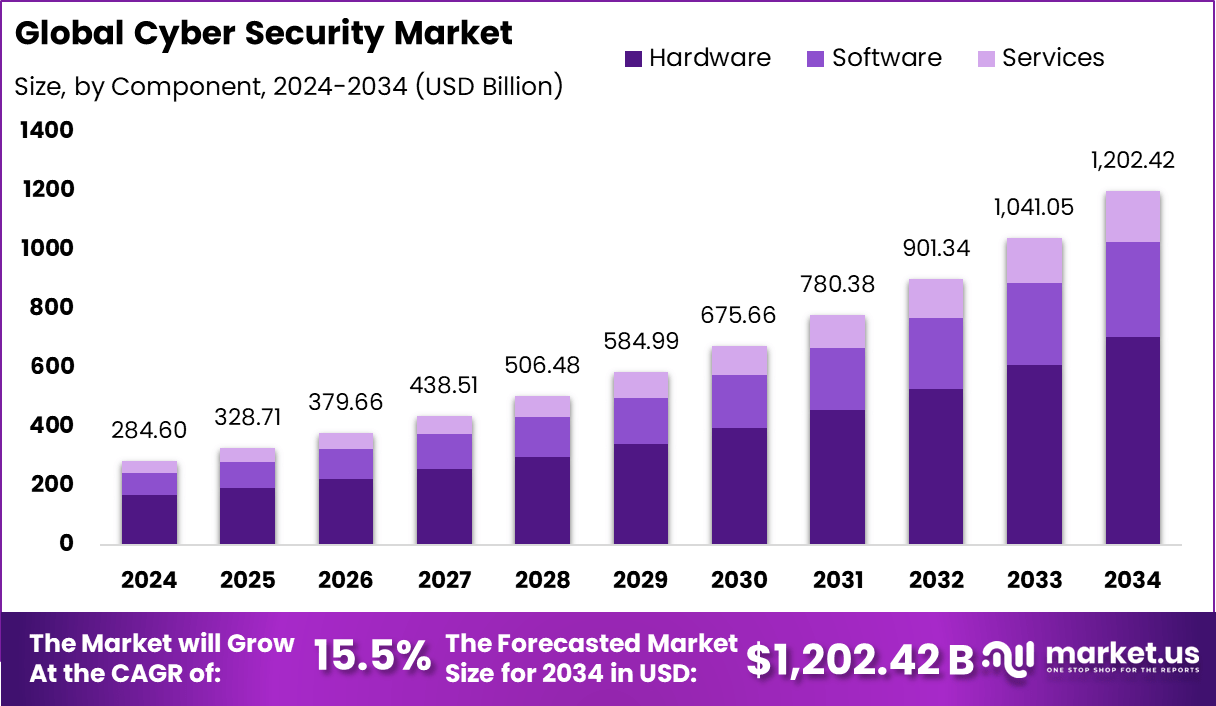
- The global cybersecurity market generated USD 284.60 billion in 2024 and is expected to expand steadily through the next decade, reflecting sustained investment in threat detection, prevention, and response capabilities.
- Market growth is projected to accelerate from USD 1,126.36 billion in 2025 to approximately USD 7,473.05 billion by 2034, representing a strong 15.50% CAGR over the forecast period.
- North America maintained a leading position in 2024, accounting for more than 39.5% of global revenue, equivalent to USD 108.15 billion, supported by early technology adoption and high enterprise security spending.
Cyber Security Industry Overview
- Hardware accounted for 58.7% of the market, driven by sustained demand for physical and device-level security infrastructure.
- Endpoint security emerged as the leading solution type with a 33.7% share, reflecting its growing importance in protecting user devices and access points.
- On-premises deployments represented 62.5%, indicating continued preference for locally managed security systems to safeguard sensitive data.
- Large enterprises dominated adoption with a 70.3% share, supported by higher cybersecurity budgets and complex risk environments.
- The IT and telecommunications sector led end-use adoption at 28.6%, highlighting its elevated exposure to cyber threats and reliance on secure networks.
- North America held a 39.5% regional share, with the U.S. market valued at USD 306.46 billion and expanding at a 20.2% CAGR, supported by strong enterprise spending and advanced security adoption.
(source: market.us)
Cyber Security Spending Trends
Investment in cyber security continues to grow as threat complexity increases and digital transformation expands organizational exposure. Global spending on cybersecurity products and services is projected to reach approximately $212 billion to $213 billion in 2025, representing a notable year-on-year increase from previous years. This growth reflects a rising commitment to defensive measures including security software, managed services, and network protection technologies.
Annual spending growth is expected to remain strong, with estimates indicating an increase of about 12 percent to 15 percent in 2025. Organizations are allocating larger portions of their IT budgets to security services, software, and network defence systems to address evolving attack vectors. This trend underscores an industry shift from reactive incident response toward proactive risk mitigation and continuous monitoring. As threat environments change rapidly, security investments are being guided by strategic frameworks that balance risk exposure, regulatory compliance, and operational priorities.
Technology and Defensive Strategies
Adoption of advanced technologies has become central to modern cyber security strategies. Defensive technologies such as intrusion detection systems, endpoint security solutions, and identity management platforms are widely used to identify and prevent unauthorized access. In addition, emerging technologies including automation and artificial intelligence are increasingly integrated to enhance threat detection and response capabilities. These technologies enable real-time analysis of network traffic, correlation of security events, and prioritization of high-risk activities.
Zero trust architectures and continuous monitoring models are being adopted by many organizations as foundational security principles. Zero trust assumes that no entity, internal or external, should be automatically trusted; instead, verification is required at every access attempt. This approach, combined with multi-factor authentication and least-privilege access controls, strengthens defenses against credential theft and lateral movement attacks. As cyber threats continue to evolve, strategic alignment of technology investments with security policies and governance frameworks remains critical for long-term resilience.
Regulatory and Organizational Considerations
Regulatory compliance and governance frameworks play a significant role in shaping cyber security practices. Many jurisdictions have implemented data protection laws that mandate security controls, breach reporting, and risk management processes. Adherence to these requirements influences how organizations prioritize security efforts, allocate budget resources, and engage with third-party service providers. Compliance initiatives also help align organizational practices with legal obligations that protect data subjects and maintain transparency.
Within organizations, risk governance functions integrate cyber security into enterprise risk management programs. Boards and executive leadership increasingly oversee cyber security as a strategic risk, rather than a purely technical concern. This shift encourages cross-functional collaboration to develop policies that align security objectives with business continuity, reputation management, and customer trust. Such organizational alignment reinforces accountability and supports sustainable investments in people, processes, and technologies.
You May Also like to Read
- Digital Banking Statistics: By Market, Usage and Security Insights
- Creator Economy Statistics and Insight
- Cybersecurity Statistics : Facts And Figures
- EdTech Statistics: Redefining Education in the Digital Age
- Podcast Statistics: Market to Reach USD 233.9 billion by 2032
Conclusion: Strategic Imperatives for Cyber Security
The cyber security landscape is defined by growing threats, increasing financial stakes, and expanding technological complexity. Data shows that threat actors are exploiting both technical vulnerabilities and human behaviour, necessitating a comprehensive risk management approach. Continued investment in technology, security awareness, and governance frameworks is required to protect digital assets and maintain operational integrity.
Looking forward, organizations that adopt proactive cyber security practices, integrate advanced detection tools, and foster a strong security culture will be better positioned to mitigate risk. By aligning security strategies with business objectives and regulatory requirements, entities can enhance resilience and protect their stakeholders in an increasingly connected digital ecosystem.
Sources:
- https://www.vikingcloud.com/blog/cybersecurity-statistics
- https://market.us/report/cyber-security-market/