

Introduction
AI Agents Statistics: AI agents are software programs that observe their surroundings, make decisions, and act without constant human input. Unlike basic AI tools that just answer questions, these agents plan steps, learn from results, and adjust over time. For example, an AI agent might check your email, book a flight, and update your calendar all in one flow.
Developers build them using large language models combined with tools for real-world tasks. They handle goals like “plan my week” by breaking them into small actions. This autonomy makes them useful in offices, homes, and factories. Companies such as OpenAI and Google lead in creating these systems as of late 2025.
Editor’s Choice
- Around 79% of enterprises use AI in at least one core business function, showing that AI has moved beyond pilot stages into daily operations.
- The U.S. AI agents market stood at USD 1.56 billion in 2024 and is expected to reach USD 69.06 billion by 2034, driven by a strong 46.09% CAGR from 2025 to 2034.
- North America accounted for the largest share of the global AI agents market at 39.63% in 2025, supported by early adoption and strong enterprise investment.
- About 74% of global enterprises rank AI among their top three strategic priorities, reflecting its growing role in long term planning.
- More than 40% of agentic AI projects are expected to be canceled by 2027, mainly due to complexity, cost, and unclear ROI.
- Most enterprises report only 10–15% productivity improvement from AI, indicating a gap between expectations and realized outcomes.
- AI spending in the banking industry is expected to exceed USD 80 billion in 2025, focused on automation, risk management, and customer engagement.
- Around 44% of U.S. consumers would use an AI agent as a personal assistant, with interest increasing to 70% among Gen Z users.
- Nearly 39% are comfortable using AI agents to schedule appointments, while 34% prefer AI to avoid repeating information.
- About 70% rely on AI agents to manage loyalty points, and 66% would use them to track and execute price drop purchases.
- Around 44% of Americans use AI tools for job searches, and 45% seek help with resumes and cover letters.
- Nearly 43% show interest in AI apps for meal planning and fitness goals, with adoption rising above 60% among Gen Z.
Market Overview
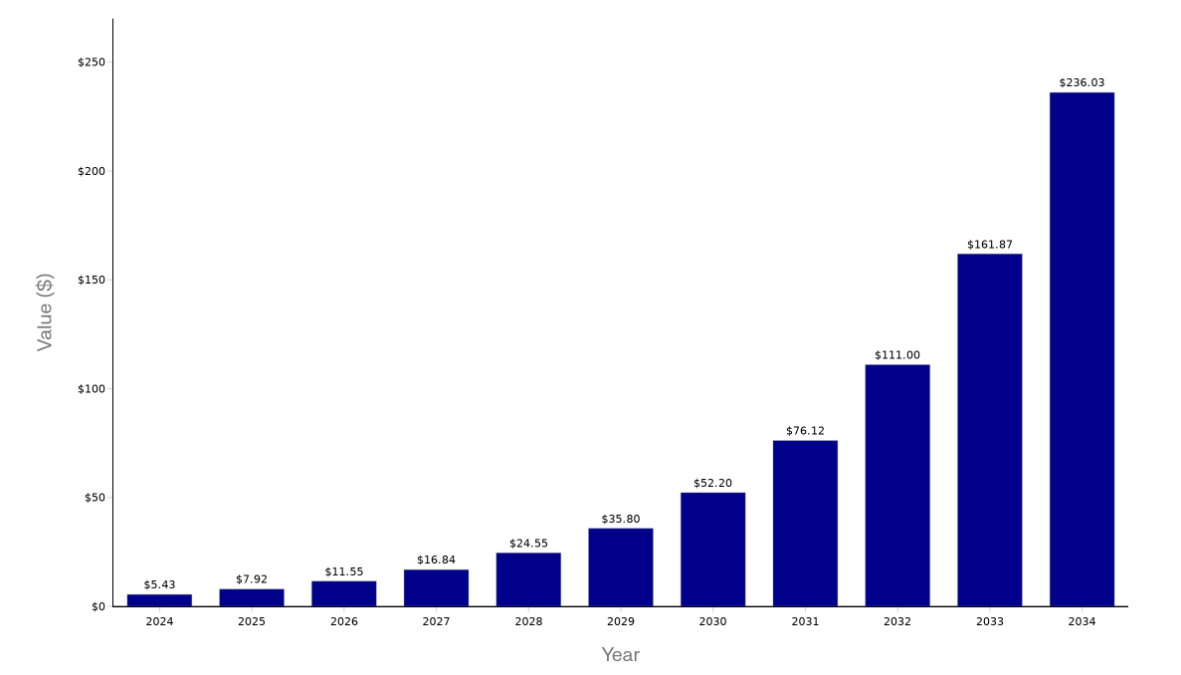
The global AI agents market is in a rapid growth phase, with a market size of USD 5.43 billion in 2024, driven by early enterprise adoption of intelligent systems for automation and decision support. In 2025, the market is expected to increase to USD 7.92 billion as organizations move from pilot projects to wider deployment of AI agents across core business functions such as customer service, software development, and operations management.
Over the long term, the market is projected to expand significantly and reach approximately USD 236.03 billion by 2034, registering a strong CAGR of 45.82% from 2025 to 2034, supported by continuous improvements in large language models, better integration of AI agents into enterprise workflows, and rising demand for autonomous digital workers across sectors including banking, healthcare, retail, and manufacturing.
Key Insights
- North America held the leading position with a 41% market share in 2024, supported by strong enterprise demand and advanced AI adoption across industries.
- Asia Pacific is expected to grow at the fastest pace during the forecast period, driven by expanding digital infrastructure and rising investment in AI technologies.
- Europe is projected to register steady growth, supported by enterprise modernization programs and a clear regulatory framework for AI deployment.
- Single agent systems dominated the market with a 62.30% share in 2024, reflecting their simplicity, lower deployment risk, and wide enterprise acceptance.
- Multi-agent systems are forecast to grow at the highest CAGR of 19.10%, as organizations move toward more autonomous and coordinated AI-driven workflows.
- Ready-to-deploy agents accounted for a 58.70% share in 2024, due to faster implementation and immediate productivity benefits.
- Build-your-own agents are expected to expand at a CAGR of 18.40%, driven by the need for customization and deeper system integration.
- Productivity and personal assistant agents recorded a strong CAGR of 29.50% in 2024, supported by rising demand for task automation and efficiency gains.
- Coding and software development agents are expected to grow at a CAGR of 19.80%, as AI adoption increases across development and testing activities.
- Enterprises led demand with a 67.10% share in 2024, reflecting large-scale deployment across business operations.
- The consumer segment is projected to grow at a CAGR of 18.20%, supported by growing use of AI agents in everyday digital applications.
| Year | Market Size (USD Billion) |
|---|---|
| 2024 | 5.43 |
| 2025 | 7.92 |
| 2026 | 11.55 |
| 2027 | 16.84 |
| 2028 | 24.55 |
| 2029 | 35.80 |
| 2030 | 52.20 |
| 2031 | 76.12 |
| 2032 | 111.00 |
| 2033 | 161.87 |
| 2034 | 236.03 |
(data source: precedence research)
Industry News and Strategic Developments
The AI agent industry continued to gain strong momentum through 2024 and 2025, supported by increased enterprise adoption and major investments from global technology leaders. These developments indicate that AI agents are moving beyond experimentation toward practical, scalable deployment across business functions.
- In May 2025, Microsoft expanded its AI agent ecosystem by launching the Agent 101 and AI Agent Hackathon through its Reactor network. The program focused on real world use of AI agents within Microsoft 365 environments and multi agent collaboration. Strong participation from developers and business teams highlighted growing demand for applied training and workflow integration. This initiative clearly supports Microsoft’s stated ambition to position 2025 as the year of AI agents, signaling a shift toward operational adoption rather than pilot projects.
- In April 2025, Alphabet introduced the Agent2Agent protocol and Agentspace toolkit at Google Cloud Next. These solutions were designed to enable secure communication and coordination among multiple AI agents across platforms. With support from more than 50 ecosystem partners, the launch marked a meaningful step toward standardizing how agents interact in enterprise settings. The move reflects rising industry focus on interoperability, governance, and scalable deployment of agent-based systems.
- In January 2025, SoftBank and OpenAI announced the formation of SB OpenAI Japan, a joint venture aimed at accelerating AI agent adoption across SoftBank’s group companies. The first initiative, known as Cristal Intelligence, targets employee productivity improvement and includes training for 1,000 staff members. This development highlights Japan’s increasing emphasis on enterprise AI transformation and internal efficiency gains through intelligent agents.
- In November 2024, Orange entered into a multi year partnership with OpenAI to strengthen business operations and customer engagement across Europe. As part of the agreement, more than 50,000 employees received access to ChatGPT Enterprise and related AI tools. This rollout demonstrates how large service providers are adopting AI agents at scale to enhance internal workflows and improve service responsiveness.
- In October 2024, Google Cloud released Vertex AI Agent Builder in public preview during Cloud Next. The low code platform allows organizations to create conversational AI agents using their own data, even with limited technical expertise. This launch reinforced Google Cloud’s strategy of lowering adoption barriers and making enterprise grade AI agent development more accessible to a wider range of businesses.
AI Agents Versus Traditional Automation
Traditional automation tools are based on predefined rules. They work well for repetitive tasks where conditions rarely change. However, they struggle when inputs vary or when decisions require context. AI agents operate differently. They rely on probabilistic reasoning and contextual understanding. This allows them to handle exceptions, adapt to new information, and operate in less structured environments.
For example, a rule based system may fail if a data field is missing or formatted differently. An AI agent can infer meaning, search for alternatives, and proceed without interruption. This flexibility is one of the main reasons organizations are moving toward agent based systems. Another difference lies in scalability. As workflows become more complex, rule based automation becomes harder to maintain. AI agents can scale more naturally by learning from experience rather than relying on expanding rule sets.
Acceptance and deployment trends
Enterprises are no longer treating AI agents as side projects. Adoption has moved into the mainstream, particularly in large organizations that already have data, cloud, and security foundations in place. Leadership teams view agentic AI as the next phase after basic chatbots and copilots, because agents can take actions across systems instead of just producing text.
Key quantified trends:
- Around 79% of organizations report that they have implemented AI agents in at least one business area as of late 2025, a clear jump from early proof‑of‑concept levels seen two years ago.
- 96% of enterprises say they plan to expand their use of AI agents in the next 12 months, and roughly half expect these deployments to become organization‑wide rather than limited to single functions.
- An estimated 23% of companies are already running agentic AI at production scale, while a further 39% are in structured pilots; together this implies that about 62% of enterprises are beyond the pure “experimentation” stage.
- Nearly 83% of surveyed decision‑makers believe that investment in AI agents is now critical for maintaining competitive advantage, which shows that sponsorship has moved from innovation teams to the C‑suite.
- About 57% of enterprises that use AI agents deployed their first system within the last two years, and 71% of these early adopters started with internal process automation rather than customer‑facing use cases.
Top use cases in enterprises
Use cases cluster around three broad themes: automating routine work, augmenting knowledge workers, and orchestrating complex workflows across multiple systems. Enterprises tend to start with low‑risk internal tasks and then extend agents into customer‑facing and revenue‑impacting journeys once trust and guardrails are in place.
Business process automation
- Around 64% of enterprise AI‑agent projects focus on process automation across finance, HR, operations, and procurement.
- Typical tasks include invoice routing, policy Q&A for employees, knowledge‑base search, and automated approvals, which makes agents a natural extension of existing RPA and workflow tools.
Customer service and experience
- Customer support remains the most visible use case, with some analyses suggesting that close to 68% of customer interactions could be handled or at least triaged by agentic AI by the late 2020s.
- Enterprises use agents to resolve simple tickets end‑to‑end, surface next‑best actions for human agents, and maintain consistent responses across channels, including chat, email, and social platforms.
IT operations and security
- IT helpdesk agents, self‑healing scripts, and incident triage assistants rank among the most common deployments in technology and telecom firms.
- In one large‑scale survey, roughly 66% of enterprises reported using agents for performance optimization and 63% for security monitoring and alert handling in at least one environment.
Developer and data‑team productivity
- About 62% of organizations say they now use agents to support code generation, testing assistance, environment setup, and documentation search.
- These agents sit alongside human developers rather than replacing them, helping teams ship features faster and reduce the burden of routine fixes.
Sales, marketing, and revenue operations
- Sales teams rely on agents for lead scoring, outbound sequencing, follow‑up reminders, and pipeline hygiene, especially in B2B software and financial services.
- In marketing, agents help with audience segmentation, content calendar management, experiment setup, and automated reporting to leadership.
HR, learning, and internal communications
- Around 55% of enterprises use AI agents to support employee onboarding, answer HR policy questions, and design personalised learning journeys.
- These agents act as always‑available “internal concierges,” reducing email traffic and freeing HR teams to focus on strategic people issues.
Supply chain, logistics, and planning
- In manufacturing, retail, and logistics, agents orchestrate demand planning, vendor evaluation, inventory thresholds, and route optimization.
- By connecting to ERP, TMS, and external data such as weather or macro indicators, they help planners respond more quickly to disruptions.
Top benefits reported by enterprises
AI leaders and business owners, three benefit themes recur: efficiency, financial impact, and experience improvements for both employees and customers. The most successful deployments are careful about measurement, often tracking baselines for cycle time, cost per transaction, and satisfaction before turning agents on.
Key quantified benefits:
Operational efficiency and cycle time
- Companies report efficiency improvements in the range of 30-55% in processes where agents handle repetitive work and hand off only exceptions to humans.
- Turnaround times for routine requests, such as password resets, policy clarifications, and basic service tickets, often fall from hours to minutes.
Cost reduction and ROI
- Several surveys suggest average cost savings of around 30-35% in high‑volume workflows, especially in support, operations, and back‑office processing.
- In customer‑experience scenarios, reported ROI frequently exceeds 100%; some benchmarks put average agentic‑AI ROI in the 128-171% range, with even higher returns in well‑optimized U.S. deployments.
Productivity and revenue impact
- Sales and go‑to‑market teams that use AI agents for prospecting and follow‑up often cite productivity gains of up to 40%, allowing them to handle more accounts without increasing headcount.
- Decision‑making speed improves by roughly 30-40% when agents sit on top of analytics systems and generate narrative summaries and recommendations for managers.
Customer and employee experience
- About 65% of B2B companies say agent‑based interactions have improved customer engagement, typically through faster responses, more consistent information, and 24/7 availability.
- Employees report less time spent on repetitive tasks and more time for judgment‑heavy work, which many enterprises now describe as a key driver of higher engagement and lower burnout.
Quality, accuracy, and risk reduction
- In data‑heavy environments, AI agents help standardize workflows, which reduces manual errors in reporting, compliance checks, and data entry.
- Security and monitoring agents catch anomalies faster and escalate them with richer context, supporting better risk management than traditional rule‑based alerts alone.
Transforming Key Industries
Healthcare Applications
In healthcare, AI agents assist doctors by reviewing patient records and suggesting treatments. They monitor vital signs in hospitals, alerting staff to issues before they worsen. For instance, agents analyze scan images to spot early cancer signs, helping rural clinics with limited staff.
Patients benefit too. Wearable devices pair with agents that track exercise and diet, then advise on changes. During the 2025 flu season, agents in apps reminded millions to get vaccines based on local data. This proactive care improves outcomes and eases pressure on systems.
Manufacturing Efficiency
Factories rely on AI agents for smooth operations. They watch machines 24/7, predict breakdowns, and order parts ahead. Tesla uses such agents on assembly lines to adjust robot arms for each car model in real time.
Quality control sees big gains. Agents use cameras to inspect products, catching defects humans might miss. Samsung applied this in electronics production, cutting waste by 20 percent in 2025. Workers shift to oversight, making jobs safer and more skilled.
Finance and Banking
Banks use AI agents to detect fraud instantly. They scan transactions, flag odd patterns, and freeze accounts if needed. JPMorgan reported in mid-2025 that agents stopped losses worth billions.
Personal finance apps employ agents to budget automatically. They review spending, suggest savings, and invest small amounts. Users in India saw agents handle UPI payments and tax filings seamlessly during the 2025 fiscal year. This builds trust and financial health.
Challenges to Address
AI agents bring risks that need careful handling. Privacy stands out, as they access emails, files, and cameras. A 2025 data breach at a major tech firm exposed agent-collected info, sparking new laws in Europe and the US.
Bias in decisions worries experts. If training data favors certain groups, agents repeat errors in hiring or lending. Companies now audit agents regularly, with tools to spot unfair patterns. Human oversight remains key for high-stakes choices.
Reliability issues arise too. Agents sometimes “hallucinate” wrong actions, like booking wrong flights. Developers add safety checks, but full trust takes time. As President Trump noted in a 2025 speech, regulations must balance innovation and protection.
Future Opportunities
Looking ahead, AI agents will integrate deeper into life. In education, they tutor students one-on-one, adapting lessons to pace. Indian schools piloted this in 2025, lifting test scores in math by 15 percent.
Agriculture gains from field agents on drones. John Deere’s systems map soil and spray crops precisely, helping Maharashtra farmers boost yields amid climate shifts. Energy firms use agents to balance grids, cutting blackouts.
Collaboration grows. Teams of agents work together, like one for planning and another for execution. By 2030, experts predict most jobs will involve agents as partners. This opens doors for small businesses in fintech and IoT.
Ethical Considerations
Ethics guide AI agent growth. Transparency builds confidence, so users know what data agents use. Firms like Oracle mandate clear logs of agent actions in enterprise tools.
Inclusivity ensures agents serve all. Developers train on diverse data to avoid cultural gaps. India’s NASSCOM pushed for local languages in agents by 2026, aiding rural users.
Sustainability matters too. Agents run on servers that use power, so green data centers expand. A 2025 study found optimized agents cut energy by 25% versus older AI.
Final Thoughts
AI agents represent a meaningful step forward in applied artificial intelligence. They move beyond passive analysis and into active participation in digital work. Their ability to operate autonomously, adapt to change, and collaborate with humans makes them a powerful tool for modern organizations.
At the same time, their deployment requires care. Clear goals, strong governance, and human oversight are essential to ensure positive outcomes. When used responsibly, AI agents can reduce friction, improve efficiency, and free people to focus on work that truly requires human insight.
Explore More
- Pickleball Statistics by Market Size and Growth
- Semiconductor Statistics, Facts and Performance
- AI Agents Statistics: Market Size, Adoption Rate and Trends
- Voice AI Agents Statistics, Market Size and Adoption Trends
- Streaming Services Statistics by Category and Emerging Trends
- Top Drone Companies Shaping Global Market Growth
Sources:
- https://www.gminsights.com/industry-analysis/ai-agents-market
- https://www.precedenceresearch.com/ai-agents-market
- https://www.multimodal.dev/post/agentic-ai-statistics
- https://masterofcode.com/blog/ai-agent-statistics