
MiniMax AI is a generative artificial intelligence company established in 2022 and based in China. Since its launch, the company has focused on building large-scale foundation models designed for multimodal content generation. Its solutions address text, image, audio, and video creation needs across consumer and enterprise segments.
Publicly shared figures indicate that MiniMax AI products have reached over 200 million cumulative users worldwide. This level of adoption reflects increasing global demand for AI-powered creative and productivity tools. The scale of usage places MiniMax among the more widely deployed generative AI platforms originating from Asia.
The company’s growth has been supported by strong investment activity and expanding enterprise use. A successful public listing has further strengthened its financial position. Overall, MiniMax AI demonstrates how generative AI platforms are transitioning from experimental tools to large-scale digital infrastructure.
Top Editor’s Choice
- MiniMax AI recorded a sharp rise in revenue, increasing from USD 10 million in September 2024 to USD 70 million in September 2025, representing a sevenfold year over year increase.
- The company completed a successful Hong Kong IPO, raising HKD 4.82 billion or approximately USD 618.6 million by pricing shares at the top end of the offer range.
- Strong investor demand led MiniMax AI to expand the offering from the initially planned 29.2 million shares to 35.2 million shares, indicating high market confidence.
- The Hong Kong IPO market posted a strong performance in 2025, raising USD 36.5 billion across 114 listings, with MiniMax AI contributing to the market’s strongest year since 2021.
Key Performance Insights
- MiniMax M2 recorded an 87.0% score while operating on a 230B parameter architecture. This result highlights strong efficiency, showing that high performance can be achieved without relying on extremely large model sizes.
- MiniMax M1 40K achieved a 96.0% score, closely aligning with top-tier results. The outcome reflects stable and reliable performance across different configurations within the MiniMax model family.
- On the SWE-bench Verified benchmark, MiniMax M2 scored 69.4, narrowing the performance gap with leading frontier models. This positions the model as highly competitive in real-world software engineering tasks.
- MiniMax M1 80K delivered a 96.8% score, supported by a 456B parameter design. The result confirms that larger architectures continue to provide measurable gains in complex reasoning and long-context tasks.
- MiniMax M2.1 achieved a 91.5% score, demonstrating successful performance retention and improvement across model generations. This indicates efficient scaling and optimization in ongoing model development.
Company Background
MiniMax AI was founded in 2022 with headquarters in Shanghai, China. The company was created to develop proprietary large language and multimodal models rather than relying on third-party systems. This strategy allowed greater control over performance optimization and deployment flexibility.
From its early stages, MiniMax adopted a vertically integrated approach that combined model research, infrastructure development, and application design. This structure reduced dependency on external vendors and accelerated product rollout. Early product releases helped the company gain rapid traction among domestic users.
As adoption increased, MiniMax expanded its focus beyond China to international markets. Multilingual support and cloud-based delivery enabled faster global distribution. The company’s foundation phase established a scalable base for subsequent growth.
Key Model Capabilities and Technical Insights
- MiniMax AI has positioned its foundation models around long-context reasoning, with MiniMax-M1 supporting up to 1 million tokens. This enables the model to process and reason over very large documents or extended conversation histories within a single session, exceeding typical large language model context limits.
- Hybrid Mixture-of-Experts architecture is central to both M1 and M2. The models use selective parameter activation with a custom lightning attention mechanism, allowing only relevant network segments to run per token. This design reduces computation requirements and improves efficiency for long-form generation.
- Model scale and efficiency are balanced through architecture choices. M1 includes 456 billion parameters, with about 46 billion active per token, while still requiring significantly fewer floating-point operations for long outputs compared with competing large models.
- Open-weight availability is a defining strategy. M1 was released under an Apache-2.0 license, and M2 followed as a fully open-sourced model in late 2025. This approach enables local deployment, fine-tuning, and broader experimentation without platform dependency.
- Reasoning and tool-use performance are core design goals. M1 demonstrated strong results across math, coding, and multi-step reasoning tasks, while M2 expands these capabilities with agent-focused design, supporting structured planning and stable execution across long tool chains.
- Agentic functionality is a key advancement in M2. The model is optimized for coordinating external tools such as code interpreters, browsers, and system shells, enabling complex workflows that combine reasoning, coding, information retrieval, and action execution.
- Cost and speed optimization are emphasized in deployment. M2 was engineered to balance performance, inference speed, and pricing, delivering faster execution at lower operating cost compared with similar large models, supporting scalable enterprise and developer use cases.
- Overall, MiniMax’s M1 and M2 models function as flexible text and reasoning engines, differentiated by extremely large context windows, open-source access, efficient architecture, and strong support for tool-based and agent-driven AI applications.
User Base and Global Reach Statistics
MiniMax AI has reported more than 200 million cumulative users across 200+ countries and regions. These users include individual creators, students, developers, and business professionals. The geographic spread highlights demand from both developed and emerging digital markets.
User engagement has been driven by accessibility and ease of use. Web-based and API-enabled products allow users to interact with AI tools without advanced technical skills. This approach has contributed to consistent growth in daily and monthly active users.
In addition to individual users, MiniMax has seen strong organizational adoption. More than 130,000 enterprises and developers have reportedly used its AI services. This mix of consumer and enterprise users supports diversified usage patterns and revenue opportunities.
Product Portfolio and Usage Metrics
MiniMax AI provides generative tools for text writing, image creation, voice synthesis, and video generation. These tools are designed to support content creation workflows at scale. They are commonly used for marketing materials, educational content, and digital media production.
Video and conversational AI products represent a significant share of platform usage. Text-to-video and AI character tools are used for short-form videos, presentations, and social media content. Audio generation tools support voiceovers and interactive applications.
Multilingual functionality allows MiniMax products to serve global audiences. This capability is particularly important for cross-border digital creators and international businesses. Usage metrics indicate growing demand for integrated multimodal creation rather than single-format tools.
Enterprise and Developer Adoption
Enterprise adoption has become a key pillar of MiniMax AI’s expansion. Over 130,000 developers and organizations have integrated MiniMax models into applications and internal systems. These integrations range from customer service automation to creative production tools.
Developers use MiniMax APIs to embed generative AI into consumer-facing products. This includes chat interfaces, content assistants, and AI-driven media platforms. High-volume API usage suggests strong confidence in model reliability and scalability.
Business adoption also reflects increasing acceptance of AI-generated content in professional environments. Companies are using MiniMax tools to reduce production time and improve output consistency. This trend supports long-term enterprise demand.
Technology and Model Capabilities
MiniMax AI develops proprietary large language and multimodal models optimized for long-context processing. These models are designed to handle complex instructions and extended conversations. Long-context capability improves accuracy and usability in professional scenarios.
The company has disclosed the use of advanced architectures such as mixture-of-experts. This approach improves computational efficiency while maintaining output quality. It also supports scaling models without proportionally increasing computing costs.
Continuous model updates are a core part of MiniMax’s technology strategy. Performance improvements focus on reasoning, coherence, and multimodal alignment. These upgrades help maintain competitiveness in a fast-moving AI landscape.
Revenue Growth Insights
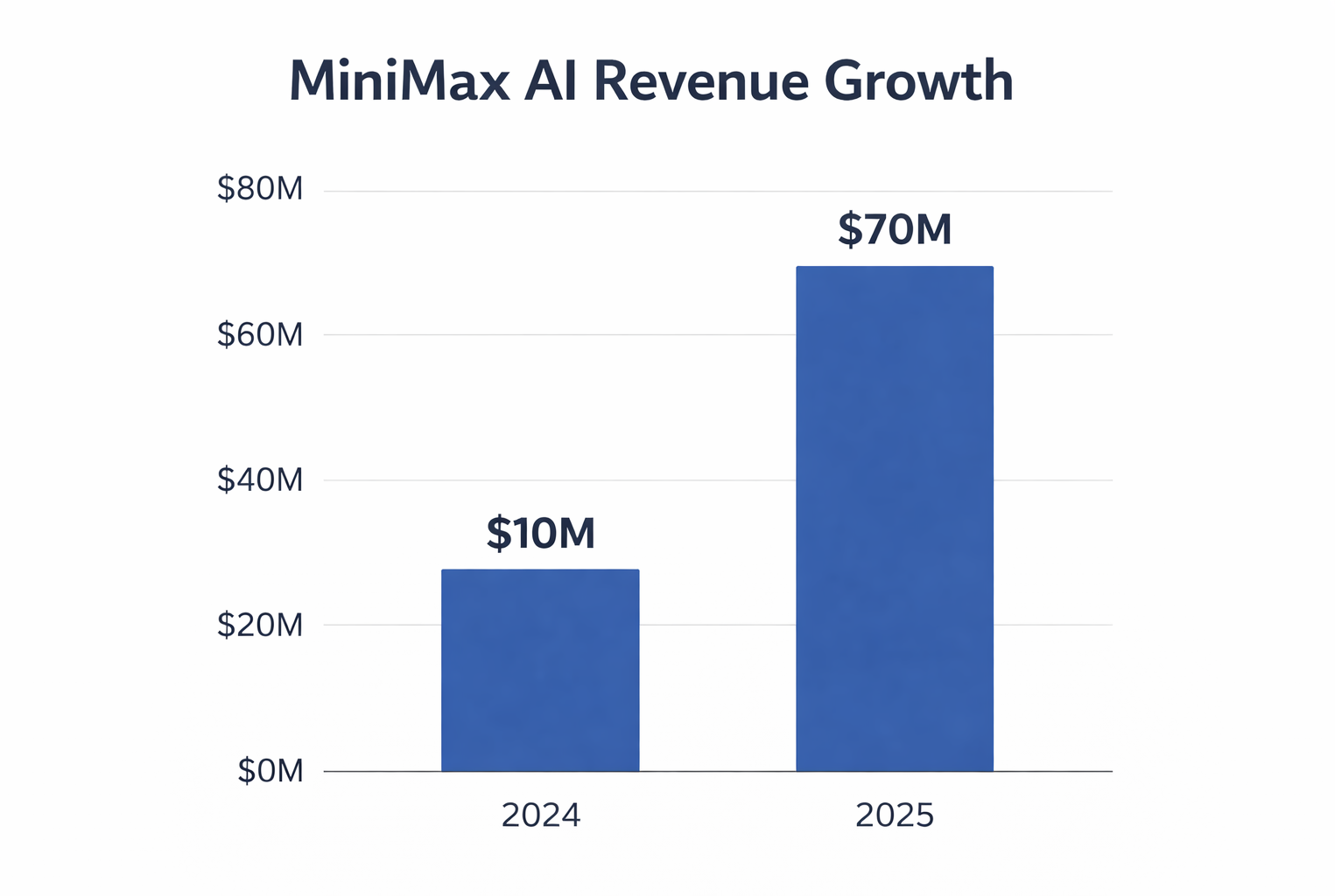
- MiniMax demonstrates a clear revenue acceleration pattern, moving from negligible revenue levels in 2022 to approximately $10.0 million in 2024, followed by a sharp rise to nearly $70.0 million in 2025. This shift reflects a transition from early commercialization to scaled monetization.
- The moderate growth observed between 2022 and 2024 suggests a period focused on product development, infrastructure buildout, and market validation rather than aggressive revenue capture. This phase appears consistent with deep investment in model training and platform readiness.
- The steep revenue jump in 2025, representing a multi-fold year-on-year increase, indicates strong market adoption. Demand is likely driven by enterprise use cases, API consumption, and broader deployment of large-scale foundation models.
- The revenue trajectory points to improved operational leverage, where incremental customer adoption translates into disproportionately higher revenue gains. This pattern is commonly associated with software-driven AI platforms once scale thresholds are crossed.
(Source: electroiq, getlatka)
Financial and Funding Statistics
MiniMax AI achieved a major milestone by listing on the Hong Kong Stock Exchange in 2026. The initial public offering raised approximately HK$4.8 billion, equivalent to about USD 619 million. This marked one of the largest AI-related IPOs from China during that period.
The funds raised were intended to support research, infrastructure expansion, and talent acquisition. Investment in computing resources remains a priority due to the high costs of training and deploying large AI models. Public listing also improved transparency and governance visibility.
Market response to the listing indicated strong investor interest in generative AI platforms. The successful capital raise strengthened MiniMax’s balance sheet. This financial position supports longer-term innovation and global expansion plans.
Top-Performing MiniMax AI Models (M1, M2, M2.1)
| Comparison Criteria | MiniMax-M1 | MiniMax-M2 | MiniMax-M2.1 (Top-Performer) |
|---|---|---|---|
| Release Period | June 2025 | 2025 (post-M1) | Late December 2025 |
| Model Positioning | Long-context and reasoning specialist | Agentic reasoning and workflow execution | Advanced full-stack and coding-optimized model |
| Total Parameters | Not publicly disclosed | 230B | 230B |
| Active Parameters | Not publicly disclosed | 10B (MoE) | 10B (MoE) |
| Architecture Type | Large foundation language model | Mixture-of-Experts (MoE) | Mixture-of-Experts (MoE) |
| Context Window Capacity | Up to 1 million tokens | 205k–230k tokens | Not specified (optimized for coding workflows) |
| Reasoning Focus | Long-context understanding and analysis | Multi-step reasoning and agentic workflows | High-precision instruction following and optimization |
| Primary Strength | Large document and codebase analysis | Planning, tool use, and long-horizon agent tasks | “Vibe coding” and full-stack development |
| Coding Performance | Suitable for large code analysis | Strong for agent-driven coding tasks | Matches or exceeds Claude Sonnet 4.5 in coding benchmarks |
| Language Support | General programming and text analysis | Broad language and tool integration | Strong multi-language support including Rust, Go, Java, TypeScript |
| Mobile App Development | Not a core focus | Supported | Superior Android and iOS native development performance |
| Agentic Capabilities | Moderate | High | Very high, positioned as an “agentic workhorse” |
| Efficiency and Throughput | Optimized for long reasoning | High throughput for interactive agents | Frontier-grade performance at significantly lower cost |
| Benchmark Recognition | Specialized for long-context tasks | Ranked #1 open-weight model on Artificial Analysis Index | Top performer in specialized coding and instruction benchmarks |
| Typical Use Cases | Large document review, codebase analysis | AI agents, planning, browsing, automation | Test generation, code optimization, full-stack development |
Regulatory and Legal Environment
MiniMax AI operates within an evolving regulatory framework for artificial intelligence. Governments worldwide are increasing scrutiny on data usage, content ownership, and AI transparency. These factors directly influence operational and compliance strategies.
The company has faced legal attention related to copyright and content generation practices. Such cases reflect broader industry challenges rather than company-specific issues. They highlight the need for stronger content controls and usage safeguards.
Regulatory alignment is expected to remain a critical focus area. Compliance investments may increase operational costs but also improve trust. Long-term sustainability will depend on balancing innovation with legal responsibility.
Conclusion
MiniMax AI has scaled rapidly through strong user growth, diversified product offerings, and expanding enterprise adoption. Public statistics show widespread global usage across both consumer and professional segments. Financial milestones further confirm its position in the generative AI ecosystem.
The company’s focus on proprietary model development and multimodal capabilities supports long-term competitiveness. Continued investment in technology and infrastructure remains essential. Regulatory adaptation will play a central role in shaping future operations.
Overall, MiniMax AI represents a significant example of large-scale generative AI deployment. Its performance highlights the growing role of AI in digital content creation. Ongoing developments will determine its sustained global impact.
Sources:
- https://www.reuters.com/world/asia-pacific/chinas-ai-startup-minimax-group-raises-619-million-hong-kong-ipo-2026-01-08/
- https://electroiq.com/stats/minimax-ai-statistics/
- https://minimax-ai.chat/blog/what-is-minimax-ai/